
A client came to me with a number most marketers would frame on the wall. Their domain was pulling a large volume of organic traffic. Rankings looked healthy, sessions looked healthy, and on paper the site was doing its job. It was not. The traffic was not turning into booked work, and nobody on the team could explain why a well-trafficked site kept losing the moment that mattered most.
So I did what I do before I touch anything else on a stalled site. I stood up real event tracking and engagement tracking and let the data tell me what visitors were actually doing, not what the traffic report implied they were doing. The answer was not a design problem or a copy problem. It was a targeting and flow problem hiding behind a traffic number that looked like success.
Here is the part that surprised the client most. Fixing it meant the traffic number went down. And the business got better. The client is now booked two months out on average, on less traffic than they started with. That is the story I want to walk through, because "more traffic" is the wrong goal if the traffic arriving is not the traffic your funnel was built for.
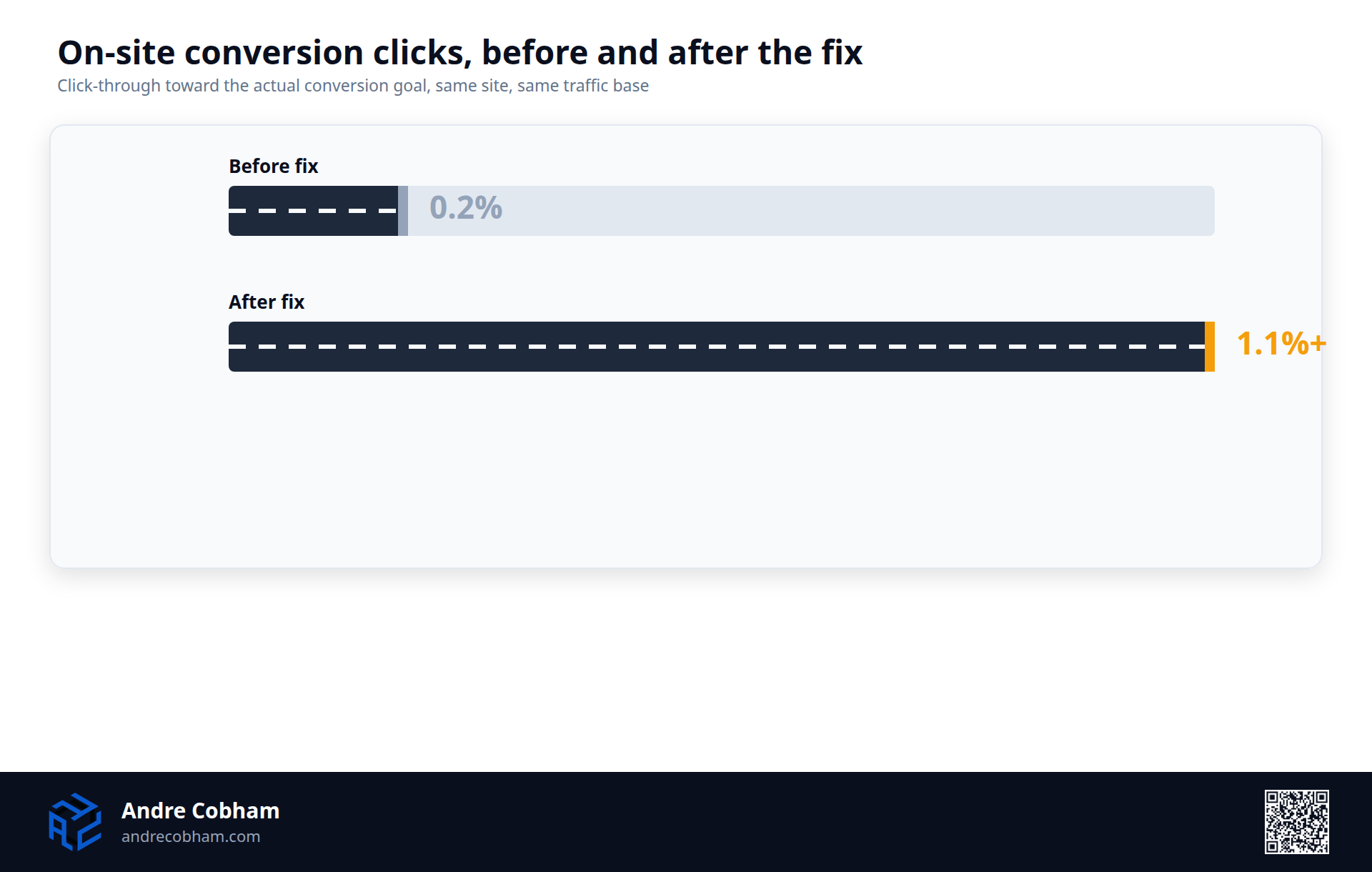
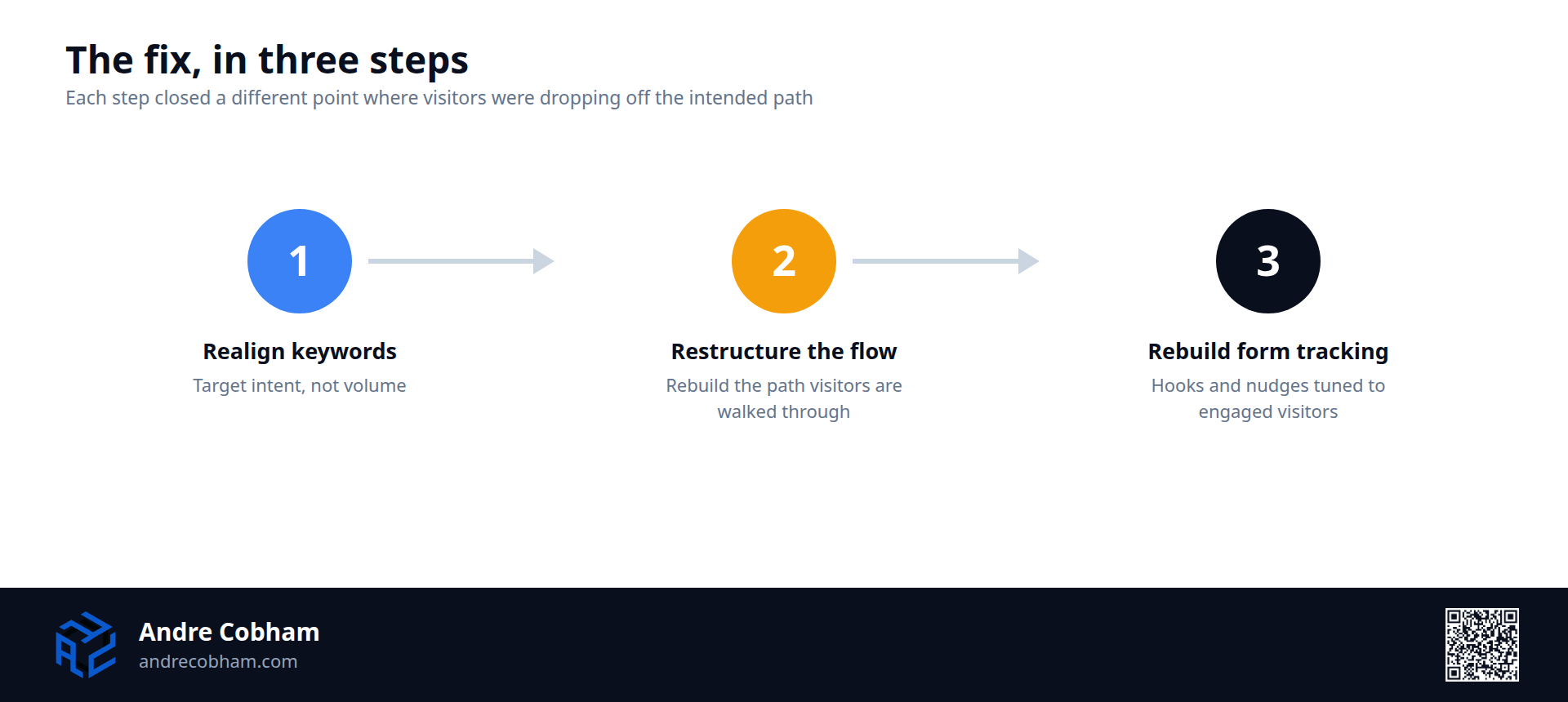
High organic traffic was masking a targeting and flow problem, not proving the site was healthy. Event tracking and engagement tracking on the site surfaced the real issue: a large share of visitors arrived on the wrong keywords, so their entry point never lined up with the intended path through the site's conversion funnels. The fix ran in three parts: realigning keyword targeting to intent-matched terms, restructuring the conversion flow itself, and rebuilding form tracking with hooks, nudges, and popups tuned to trigger for visitors showing deeper engagement lower in the journey. On-site clicks toward the goal moved from 0.2 percent to just over 1.1 percent, and the client now books two months out on average. The tracking layer behind all of it can be built on a cloud service like Google Tag Manager or on a self-hosted open-source alternative. Both are legitimate paths, and the right one depends on the business, not on a universal rule.
Traffic is a proxy metric. It stands in for the thing you actually want, which is booked work, and proxies are only useful when they move in the same direction as the real number. On this site they had come apart. Traffic climbed for months while booked jobs stayed flat, and nobody had gone looking for why because the top-line chart still pointed up and to the right.
High traffic was hiding a different problem
The client's instinct going in was reasonable. Traffic was up, so the marketing was working, and if bookings had not followed yet, that was assumed to be a sales problem or a seasonality problem. Every one of those explanations kept the traffic chart innocent. None of them were true.
What actually happens on a site like this is quieter than a sales problem. Visitors arrive, look around briefly, and leave without doing the one thing the business needs them to do. Standard analytics tools show that as a bounce rate or a session duration, which is not specific enough to fix anything. You can watch a bounce rate for a year and never learn what was wrong with the visit, only that something was.
The fix does not start with a redesign or a new round of ad spend. It starts with finding out, at the level of individual clicks and individual pages, where the visit actually breaks down. That requires instrumentation the site did not have yet, which is the first thing I built.
Standing up event tracking and engagement tracking
Before I can fix a conversion problem I need to see it, and seeing it means tracking events, not just pageviews. A pageview tells you someone loaded a URL. An event tells you whether they scrolled to the pricing section, whether they opened the contact form and abandoned it, whether they clicked a call-to-action and then left the page anyway. That is the layer most under-instrumented sites are missing, and it is the layer that actually explains lost conversions.
There are two credible ways to build that layer, and I do not think one is universally correct. Google Tag Manager is the cloud path. It is fast to deploy, it integrates cleanly with the rest of the Google ecosystem the client was already using for ads and search, and it puts event tracking in the hands of anyone comfortable with a tag manager interface rather than a developer. For a team that wants to move quickly and is already inside Google's tooling, that is a real advantage.
The other path is a self-hosted, open-source alternative. Tools in that category keep the raw event data on infrastructure you control, which matters for a client with privacy requirements or a preference for owning their own analytics stack outright rather than routing every visitor event through a third party. The tradeoff is that someone has to run and maintain that infrastructure, which is a real cost that a cloud tool absorbs for you.
Neither path is the right answer for every business. The right question is not "which tool is best," it is "who is going to own this data, and how fast do we need to move." For this engagement, the deciding factor was speed and the client's existing Google-centric workflow, but I have made the opposite call for other clients whose priorities ran the other way. What matters is that the tracking gets built at all, honestly and at the event level, because without it every conversion problem stays invisible.
What the data actually showed
Once event and engagement tracking were live, the picture came into focus fast. The traffic was real. It was not bot traffic, and it was not irrelevant traffic in the sense of visitors who had no business being on the site at all. The problem was more specific than that. A large share of visitors were arriving on keywords that did not match the path the site was actually built to walk them through.
Picture a funnel built around one intended entry point. A visitor is supposed to land on a page that frames the problem the way the business solves it, then move through a short, deliberate sequence toward the conversion action. When traffic arrives instead on a keyword that puts the visitor somewhere else in that logic, they land technically on-site but conceptually off-path. They are not confused enough to bounce immediately, which is why the top-line numbers looked fine, but they are also not on the route that was built to convert them. They wander, they do not find the next intended step, and they leave.
That is the finding in one sentence. The traffic volume was masking a mismatch between where people were arriving and where the conversion funnel was designed to receive them. Fixing the mismatch, not adding more traffic, was the actual work.
Fix one, realigning keyword targeting
The first fix was to stop treating keyword volume as the target and start treating keyword intent as the target. Every keyword the site was ranking for or bidding on got evaluated against one question: does a visitor who searches this term actually want the thing this funnel delivers, and does the page they land on match that intent honestly?
Some keywords that had been driving real volume were quietly dropped or deprioritized once it was clear they were pulling in visitors whose actual need diverged from what the funnel offered. Volume that does not convert is not free. It costs attention, it costs analytics noise that hides the traffic that does matter, and in a paid context it costs real money for clicks that were never going anywhere. Realigning targeting meant accepting a smaller, more accurate top-line traffic number in exchange for a visitor pool that actually matched the funnel underneath it.
Fix two, restructuring the conversion flow and form tracking
Realigned keywords only help if the destination they land on is built correctly, so the second fix was restructuring the conversion flow itself. This meant re-examining the sequence a visitor is walked through after arrival, tightening the path between the moment they land and the moment they are asked to act, and removing the points where the earlier version of the funnel let an interested visitor drift off without ever reaching a call to action.
The third and most granular fix was optimized form tracking. Instead of treating the contact or booking form as a single conversion event, it got instrumented at the field level, which surfaces exactly where a visitor starts filling out a form and then stops. That data fed directly into a set of conversion hooks, nudges, and popups built to trigger specifically for visitors who were already showing deeper engagement lower in the journey, the ones who had scrolled past the fold, opened the form, or spent real time on a pricing or service page. Rather than interrupting every visitor with the same generic prompt, the site now nudges the visitors who have already shown intent, at the moment their engagement signals say they are close.
What changed, and why less traffic can mean more business
The result is the number I opened with. On-site click-through toward the actual conversion goal moved from 0.2 percent to just over 1.1 percent, more than five times higher, on a smaller and more precisely targeted traffic base than the site had before the fix. The client is now booked two months out on average. That is the outcome that matters, and it happened alongside a drop in raw traffic volume, not in spite of one.
The lesson generalizes past this one client. A traffic chart trending upward tells you visits are increasing. It does not tell you those visits are the ones your funnel was designed for, and it does not tell you whether your site is actually walking them toward the outcome you need. If your bookings or sales have stayed flat while traffic climbed, the honest next step is not more content or more spend aimed at the same keywords. It is instrumenting the site well enough to see where the mismatch actually lives, then fixing the entry point and the flow before you spend another dollar chasing volume.
My Take
Traffic is the easiest number to report and the easiest one to be proud of, which is exactly why it gets treated as the goal instead of the proxy it actually is. I would rather hand a client a smaller traffic number that converts at five times the rate than a bigger one that flatters a dashboard and does nothing for the business. The site in this case study did not need more visibility. It needed the visibility it already had pointed at the right door.
What I would not do is assume a traffic drop is automatically a fix working. The only way to know is the same tracking discipline that found the problem in the first place: instrument the events, watch where engagement actually breaks down, and let that data decide what changes next. Whether that instrumentation runs through Google Tag Manager or a self-hosted open-source stack is a real decision worth making deliberately, but it is secondary to the discipline of building it at all.
That is the same standard I hold every site I touch to. A rising traffic chart is not evidence of a healthy funnel. A rising conversion rate is.
If your traffic looks healthy but your bookings have not followed, let's find out where the mismatch is.