
Memory is the most boring line item in technology, and right now it is the most important. Not the memory in your laptop. The memory market. In the first three months of 2026, conventional DRAM contract prices jumped between 93 and 98 percent in a single quarter, according to TrendForce. That is not a typo, and it is not a spike that already passed. It is the leading edge of a supply squeeze that touches everything you buy with a chip in it, from a new workstation to a cloud invoice to the per token price of the AI tools your team now runs every day.
The company at the center of the next chapter is one most business owners have never heard of. ChangXin Memory Technologies, known as CXMT, is China's largest maker of DRAM, and it just opened one of the biggest stock listings of the year to fund an expansion that would make it the world's number two memory producer by capacity. I want to walk through what actually happened, strip out the geopolitics theater, and land on the part that matters to you. What this does to your costs.
Here is the interpretation to kill first. This is not a story about cheap Chinese RAM flooding the market and rescuing your budget. That was my first read too, and it is wrong. CXMT is not competing on price. It is competing on supply. That difference decides what your next hardware refresh costs.
DRAM contract prices spiked 93 to 98 percent in one quarter as AI demand drained memory supply, and server memory lead times stretched past 40 weeks. CXMT, China's largest DRAM maker, opened a roughly $4.3 billion listing to fund a capacity ramp that could make it the world's number two producer by wafer output. The surprise is that CXMT prices its DDR5 at parity with Samsung, SK Hynix, and Micron, not below them. It adds supply, not discounts. When you cannot get parts for nine months, availability is the product. High-bandwidth memory for AI is the one wall CXMT has not cleared, and that is the segment driving the whole squeeze. For a business budgeting hardware, cloud, and AI tooling, treat memory as a rising structural cost and order early, not as a temporary blip.
Two kinds of memory sit inside this story, and they are quietly converging. There is the physical memory CXMT manufactures, the DRAM and high-bandwidth memory that AI accelerators are starving for. And there is the machine memory researchers are fighting to expand, the context an AI model can hold and actually use. Both are bottlenecks. Both are getting expensive. I will connect them before the end, because the same word is solving the same problem at two layers of the stack.
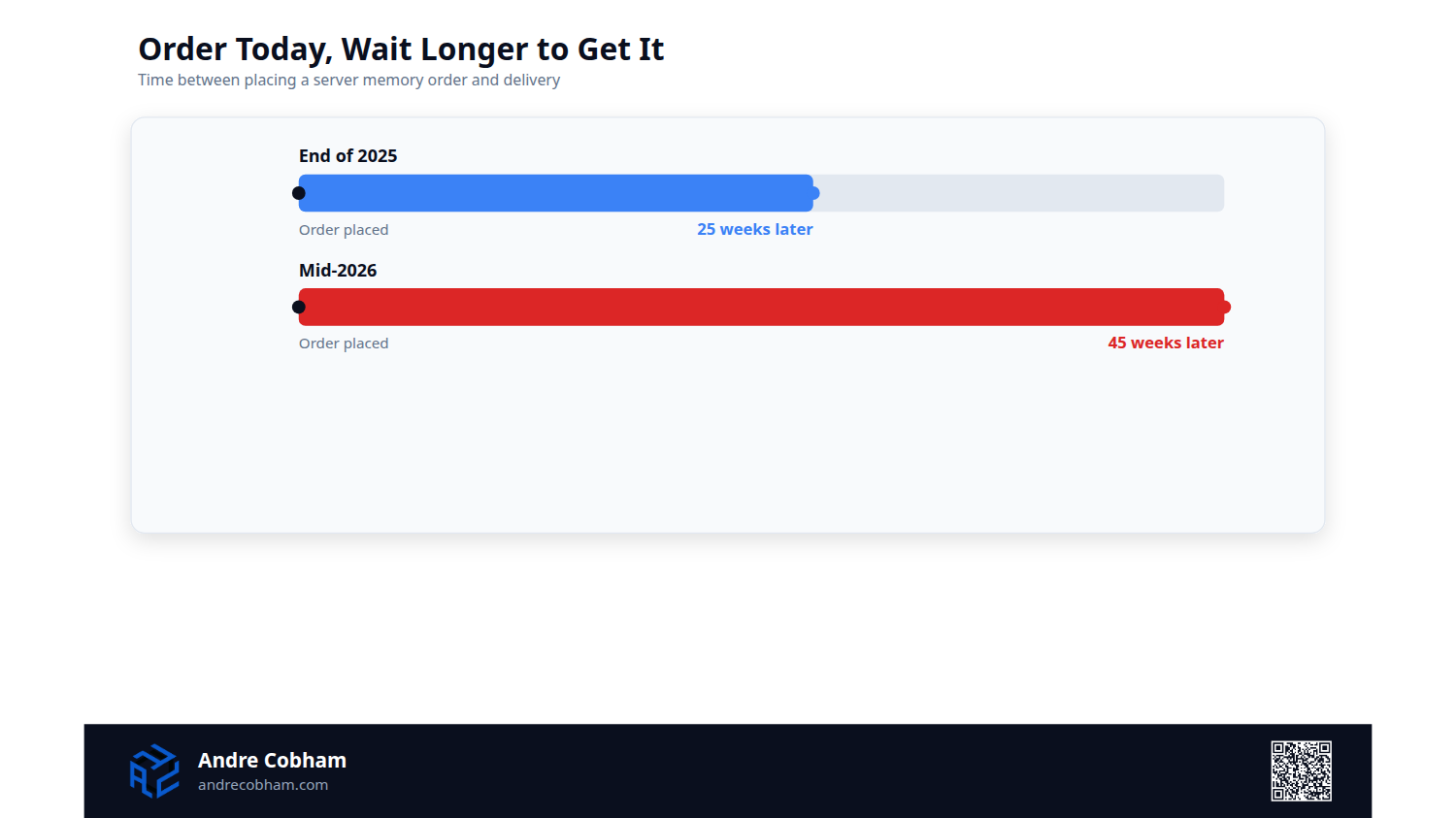
The memory market broke in a single quarter
Start with the number that reframes everything. DRAM contract prices rose by close to 95 percent quarter over quarter in the first three months of 2026. Memory that a laptop, server, or phone maker bought in December cost nearly double by March. This was not a manufacturing accident or a natural disaster. It was demand, and the demand came from artificial intelligence.
Every large AI system runs on accelerators, and every accelerator is fed by memory. The training and inference buildout consuming the industry needs memory in volumes the market was not built to supply, and the biggest producers redirected their best capacity toward high-margin high-bandwidth memory for data centers. That pulled supply away from the ordinary DDR5 that goes into the machines your business actually buys. When supply leaves a market and demand does not, price is the only variable left to move. It moved.
This matters to you even if you never touch an AI model directly. The memory in a new workstation, a network appliance, a point of sale terminal, or a server refresh is priced by the same market. When the memory line doubles, the finished device gets more expensive, and that cost lands on your next purchase order.
Price is only half of it. The other half is whether you can get the part at all. Delivery data tells the sharper story. Memory lead times stretched from roughly 25 weeks to more than 45 weeks by the end of 2025, and in July 2026 the contract manufacturer Inventec warned that server memory lead times had passed 40 weeks. Some specialized grades run 40 to 58 weeks, which means an order placed today may not arrive until well into 2027. SHI's study of the shortage for data center buyers tells procurement teams to plan for elevated pricing and tight allocation through at least the third quarter of 2026. The scarce resource is no longer a good price. It is a firm delivery date.
Who CXMT is and how fast it arrived
CXMT was founded in 2016. In under a decade it has become China's largest DRAM manufacturer and the country's only large-scale producer of modern DDR5, LPDDR5, and LPDDR5X memory. That timeline is the part worth sitting with. Building a competitive memory fabrication business is one of the hardest things in manufacturing, and CXMT compressed it into a fraction of the time competitors usually spend just getting a single product line qualified.
The scale is now real. Analysts estimate CXMT will finish 2026 at roughly 350,000 wafer starts per month, which would put it only about 25,000 wafers a month behind Micron and make China the world's second-largest DRAM producer measured by wafer capacity. Its share of the global DRAM market has climbed from low single digits to roughly 8 percent, with a credible path toward 15 percent.
The financing behind that ramp is the news of the moment. In July 2026, CXMT opened subscriptions for a STAR Market listing of around $4.3 billion, one of China's largest of the year. Underneath the listing sits a first quarter in which revenue rose 719 percent year over year and the company swung from a heavy loss to a substantial net profit. A company growing revenue at that rate, in a market this tight, funded by capital this deep, is not a rumor. It is a structural fact you can plan around.
The DDR5 surprise, parity pricing not bargains
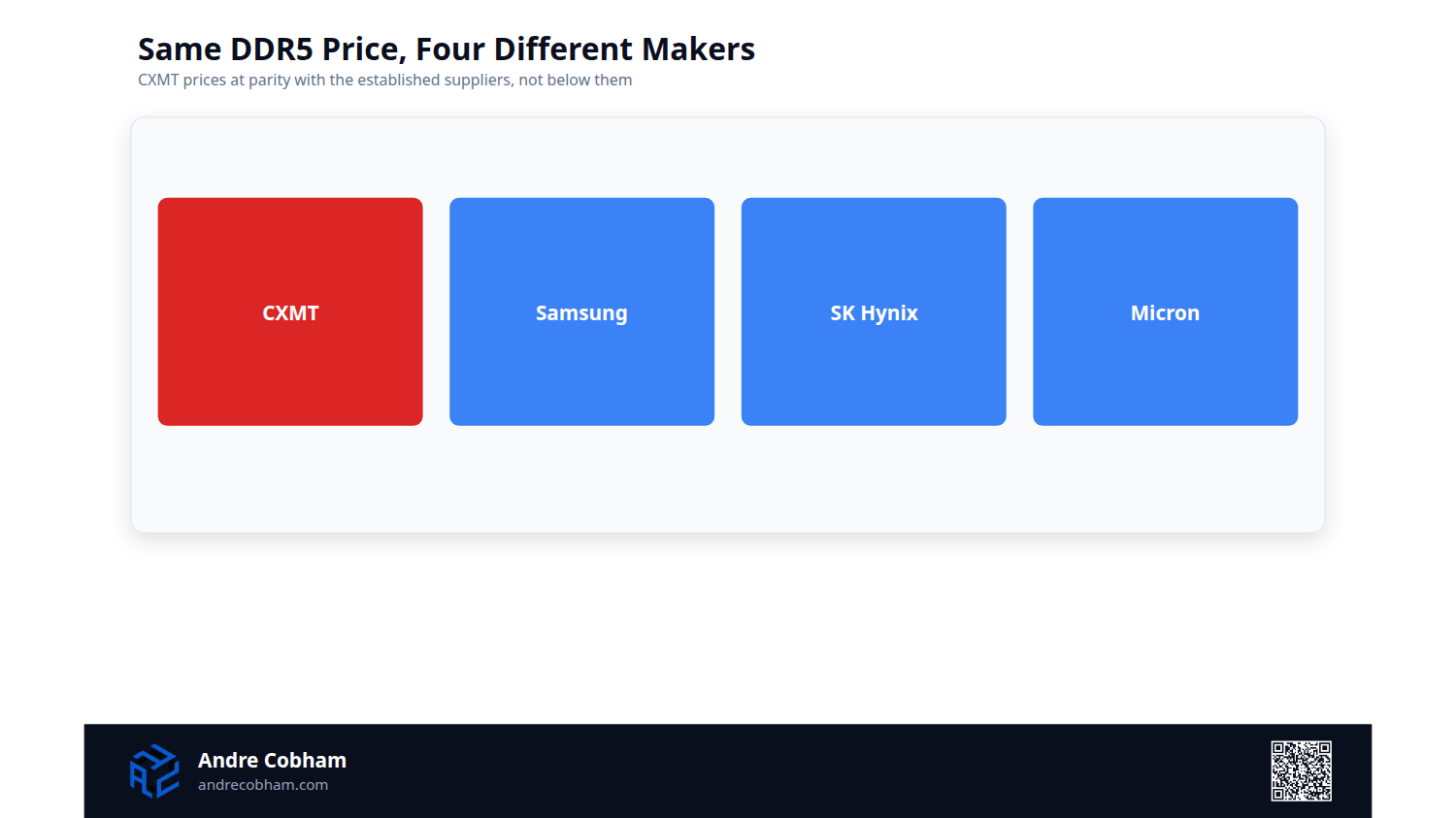
Now the part that breaks the expected narrative. When a large new supplier enters a market, the reflex is to assume prices fall. Buyers waiting on the sidelines assumed CXMT would undercut the incumbents and hand them a discount. It did not happen. CXMT prices its DDR5 at essentially the same level as Samsung, SK Hynix, and Micron.
Read that as a strategy, not an accident. In a market where every supplier is sold out and lead times run past 40 weeks, the scarce thing is not a low price. It is a guaranteed shipment. CXMT is selling supply flexibility and commercial terms, a second source when the big three cannot deliver on time. For a manufacturer whose production line stalls without memory, a reliable second supplier at market price is worth more than a cheap one that cannot commit volume. CXMT understood that and priced accordingly.
The forward pricing confirms the market is not loosening on its own. TrendForce expects server DRAM contract prices to rise a further 13 to 18 percent quarter over quarter in the third quarter of 2026, with a server DRAM shortage already forecast into 2027 as supply growth lags demand. A new supplier pricing at parity into that curve is a supplier that expects the shortage to last.
Real price relief is still plausible, but it is later and conditional. Once CXMT reaches yield parity on DDR5, expected toward the end of 2026, it is positioned to compete harder on the lower and middle end of the market, the memory in mainstream PCs, phones, and appliances. Until then, treat the arrival of a huge new supplier as added capacity that keeps the shortage from getting worse, not as a coupon. The distinction changes how you time a hardware purchase.
The HBM wall CXMT has not cleared
There is one segment where CXMT is still climbing, and it happens to be the segment driving the entire squeeze. High-bandwidth memory, or HBM, is the specialized stacked memory that sits next to AI accelerators. It is where the margin is, where the demand is most intense, and where the technical bar is highest.
CXMT has made real progress. Reports credit it with reaching technology parity on HBM3 and narrowing China's gap to the Korean leaders to roughly three years. Technology parity is not the same as production parity, though. The constraint is yield, the share of manufactured chips that come out usable, and CXMT's yield still trails Samsung and SK Hynix. Its target of high-volume HBM3 production by the end of 2026 has already shown signs of slipping, with the product still in sampling as of the spring.
This is the honest limit of the story. CXMT can relieve pressure on the everyday DDR5 that goes into your equipment. It cannot yet relieve pressure on the HBM feeding the AI data centers, and that is the demand pulling the whole market tight. The squeeze eases at the edges before it eases at the core.
Silicon memory and machine memory are the same bottleneck
Here is where the two meanings of memory meet. The reason data centers are inhaling every HBM chip that leaves a fab is that AI models are hungry for context, and context lives in memory. The physical scarcity CXMT is racing to relieve is the hardware side of a problem researchers are attacking from the software side at the same time.
The software limit is real and measurable. A modern model's usable working memory begins to degrade well before its advertised context window fills, often around 100,000 tokens, a failure researchers call context rot. A team at MIT CSAIL recently proposed a different answer, called Recursive Language Models. Instead of asking how to make a model hold more, they asked how to make it search better, treating context as an environment to explore rather than a block to memorize. Separately, MIT neuroscientists modeling human memory have suggested that star-shaped brain cells called astrocytes may store far more information than neurons alone, a biological hint at how much headroom memory architecture still has.
I have written about this software side before, because it decides what your AI tools can actually do. If you want the practical version, our piece on the attention memory divide and what your context window actually does explains why a bigger window is not the same as a better memory, and our follow up on the memory update the industry celebrated covers why the fixes shipped so far did not close the gap. The point that connects both to CXMT is simple. Memory is the binding constraint of this computing era, in silicon and in software, and Chinese fabs and MIT researchers alike are spending enormous effort to loosen it.
What the squeeze means for your costs
Strip away the geopolitics and the acronyms, and this becomes a budgeting question. Here is how I would treat it for a business planning technology spend over the next year.
Assume memory stays expensive and order early. The AI-driven demand behind the squeeze is structural, not a passing spike, and TrendForce already forecasts the shortage running into 2027. Price a hardware refresh now rather than assuming relief arrives on your schedule, and account for the lead time, not just the price. If server memory quotes run 40 weeks or more, an order you place today lands next year, so the planning horizon matters as much as the budget. Watch your cloud invoices for the same reason, because instance pricing eventually reflects what the underlying memory costs the provider.
Do not wait for a Chinese discount that is not on offer yet. CXMT adds supply and stability, which lowers the risk of a part being unavailable, but it is not cutting prices today. The benefit you get now is availability, not savings. If a discount arrives, it comes to the low and mid range later in the cycle, and you can adjust then.
Right-size your AI footprint. Because memory is the expensive constraint on both sides, efficiency is where the money is. A workload that fits a smaller model, a shorter context, or a local machine avoids paying the memory premium twice. This is exactly why the software research above matters commercially. Using memory well is cheaper than buying more of it, in your data center and in your token bill alike.
My Take
CXMT is the most consequential company in technology that most business owners have never heard of, and the reason is not politics. It is that memory quietly became the binding constraint of the AI era, and CXMT is the one new entrant with the capital and the capacity to change the supply picture at scale. That it chose margin over a price war tells you how tight the market really is. When a new competitor can charge full price on day one, the shortage is not a story. It is the condition.
What I would not do is treat this as someone else's problem three supply chains away. The memory market sets the floor under the cost of nearly every device and cloud service your business runs, and that floor just rose sharply. The winners over the next two years will not be the companies that found cheaper memory. There is no cheaper memory yet. They will be the ones who used memory well, chose efficient tools, timed their purchases with eyes open, and planned for a market that stays tight rather than hoping it loosens on cue.
That is the same discipline I bring to every system I build for a client. Understand the real constraint, design around it, and stop paying for the version of the problem that no longer exists.
If you want a technology plan built around where costs are actually heading, not where they used to be, let's talk about your stack.