Three years ago I made a deliberate call to build on Anthropic. Not because the hype was loudest, it was not, but because the quality of the output was consistently different. The reasoning held up under real workloads. The structured extraction was reliable. The model did not confidently hallucinate when it did not know something, which is rarer than the marketing of any frontier lab would have you believe.
That call has been tested at every model release cycle since. The SpaceX infrastructure deal and the June 2026 token pricing adjustments are the most recent stress test. Here is what I actually think about both.
Three Years with Claude and What Changed Version by Version
Claude 1 was where I first noticed the difference. I was using GPT-3.5 for most client work and testing Claude as a secondary option. The thing that stood out was not raw fluency. Both models were fluent. It was refusal quality. When Claude did not know something or was not confident, it said so in a way that was actually useful. GPT-3.5 at the time would often generate a plausible-sounding wrong answer with the same confidence as a correct one. For production systems that surface outputs to clients, that distinction matters enormously.
Claude 2 added the 100,000-token context window, which at the time was genuinely novel. I used it immediately for long-document analysis tasks, contract review pipelines, and batch processing of research corpora where previous models had required chunking strategies that introduced their own errors. The context length solved a real workflow problem for clients who had large documents and needed synthesis across the full text.
Claude 3 in March 2024 was the biggest jump. Haiku, Sonnet, and Opus as a tiered family was the right product architecture. It meant I could route tasks by complexity and cost rather than running everything through the most expensive model. Haiku became my default for classification, extraction, and routing tasks. Sonnet handled drafting and analysis. Opus was reserved for tasks where reasoning depth justified the price. That tiering is how I still think about model deployment today.
Claude 3.5 Sonnet, released mid-2024, was the version where the coding capability crossed a threshold that changed how I work. The ability to reason about existing codebases, identify bugs, and produce correct multi-file edits reliably enough to run in automated pipelines was a step change. I moved significant portions of my development tooling to use it. By the time Claude 3.5 Haiku launched, I had enough production data to say with confidence that the quality-per-dollar on Haiku tasks was better than any alternative I had tested.
The SpaceX Starshield Infrastructure Deal and What It Signals
In 2025, news emerged that Anthropic had secured a compute partnership involving SpaceX's Starshield infrastructure. Starshield is SpaceX's government-focused satellite and computing division, distinct from the commercial Starlink network. The reported deal involves dedicated compute capacity that is physically and logically separate from standard commercial cloud infrastructure.
The immediate reaction in the developer community was to treat it as a government contract story. I read it differently. Anthropic has been capacity-constrained. During peak periods in 2024 and early 2025, API latency was noticeably higher and rate limits were tighter than I would have wanted for production workloads. Securing dedicated, non-shared compute infrastructure is a direct answer to that constraint. The Starshield channel gives Anthropic a supply of compute that does not compete with AWS or Google's own model serving priorities.
The broader funding context matters here. Anthropic has raised $7.3 billion in total funding as of early 2026, with Google and Amazon both as significant investors. Amazon's investment came with a commitment to deploy Claude models through AWS Bedrock, and Google's investment aligns with Anthropic's presence on Google Cloud. Those investments are strategic: both hyperscalers want access to Claude's quality without Anthropic being solely dependent on either. The Starshield deal adds a third compute pillar that is independent of both.
For builders, the signal is reliability. A lab with three independent compute channels and $7.3 billion in backing from the two largest cloud providers is not going dark. That is not a given for every frontier lab in this market.
Token Pricing Comparison (per Million Tokens, June 2026)
Claude Haiku 3.5 at $0.80/$4.00 per MTok remains the lowest-cost option among the four major model families for input-heavy workloads. Pricing sourced from Anthropic, OpenAI, and Google pricing pages as of June 2026.
Token Pricing and What the Trajectory Means for Builders
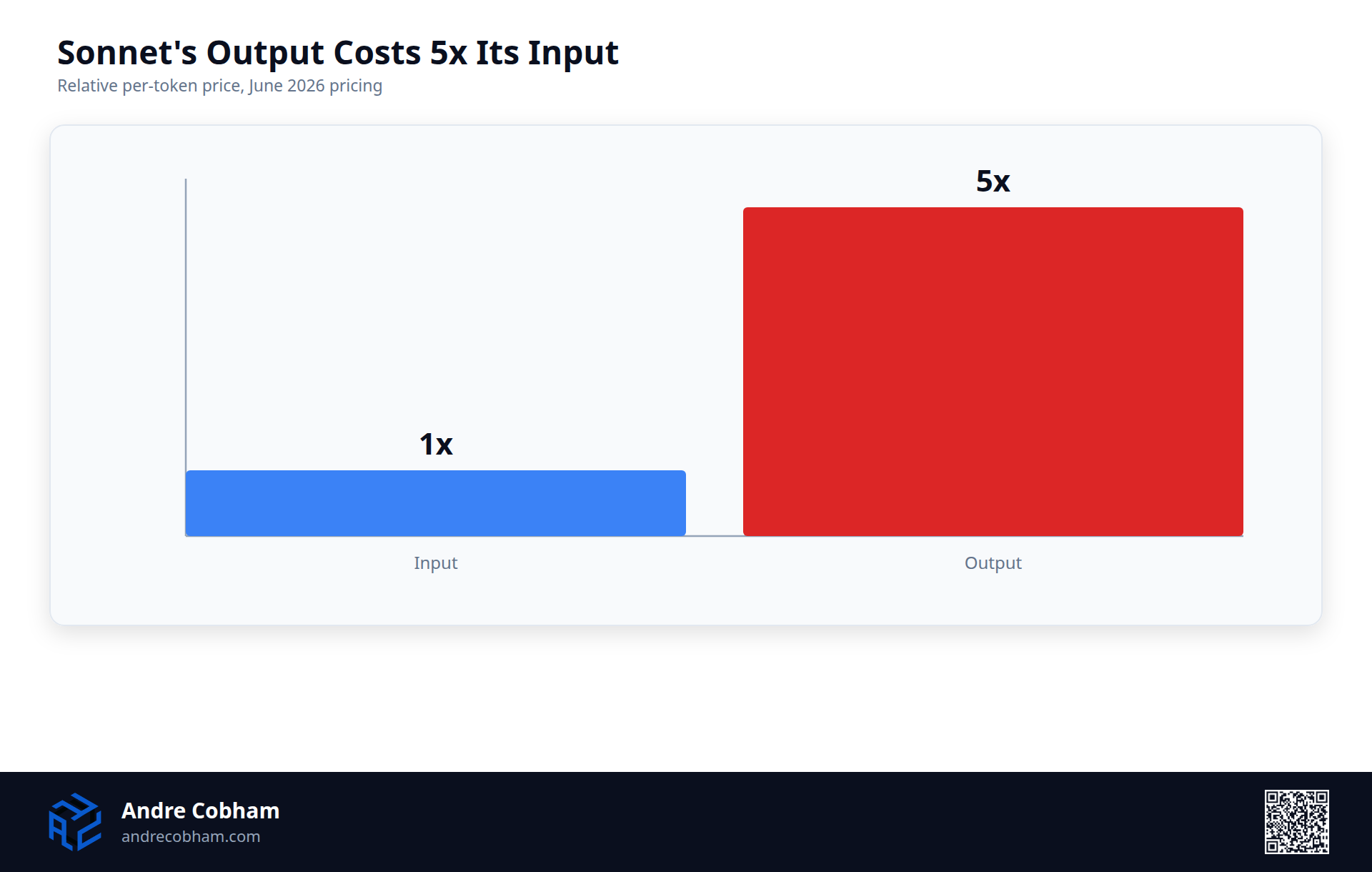
As of June 2026, Claude Haiku 3.5 runs at $0.80 per million input tokens and $4.00 per million output tokens. Claude Sonnet 4.6 is $3.00 input and $15.00 output. For comparison, GPT-4o is $2.50 input and $10.00 output, and Gemini 1.5 Pro is $1.25 input and $5.00 output. These are the published rates from each provider's pricing page.
The input-to-output ratio spread matters more than the headline number for most production workloads. A document analysis pipeline that reads a large context and produces a short structured output is dominated by input costs. A content generation pipeline that takes a short brief and produces long-form copy is dominated by output costs. The 5x multiplier on Sonnet's output relative to input means the task type determines whether Sonnet or an alternative wins on cost.
For SMBs running their own AI integrations, the routing decision is the most important cost lever. Running every task through Sonnet when Haiku would produce acceptable quality at one-quarter the output cost is a significant unnecessary expense. I route everything I can to Haiku first, escalate to Sonnet when complexity or reliability requirements justify it, and reserve higher-tier models for tasks where output quality is directly tied to revenue or client deliverables.
The pricing trajectory across all frontier labs has been consistently downward over the past 24 months. Haiku 3.5's input pricing is roughly 85% lower than comparable Claude 2 pricing for equivalent context sizes when adjusted for capability. That trend suggests that 2026 pricing is not the floor. Builders who design systems today assuming current pricing will hold are potentially over-engineering cost optimization at the expense of simpler architectures.
Constitutional AI and Why It Matters for Production Systems
Anthropic published the Constitutional AI methodology in December 2022. The short version: instead of relying solely on human feedback to shape model behavior, you give the model a set of principles and train it to evaluate and revise its own outputs against those principles. The goal is more consistent, more interpretable alignment behavior that scales better than pure RLHF as models get larger.
For me, the production-relevant outcome of this methodology is the calibration of uncertainty. Models trained with Constitutional AI principles tend to have better-calibrated refusals and uncertainty statements. They are more likely to say "I am not confident about this" when they should and less likely to generate confident-sounding wrong answers. That property is not universal or perfect, but it is measurably more consistent than models trained without it in my experience across workloads.
In production systems, hallucination is not evenly distributed across task types. It concentrates in tasks that require precise factual recall under conditions where the model's training data is sparse or conflicting. For those tasks, having a model that surfaces uncertainty rather than inventing answers is the difference between a system that requires human review and one that can run autonomously. The Constitutional AI methodology is Anthropic's bet on how to get there systematically rather than by patching outputs case by case.
My Recommendation for Builders Choosing a Model Provider in 2026
Build on a tiered family from a provider with genuine infrastructure stability. Single-model providers are a fragile dependency. If your entire stack runs on one model at one price point and that model is deprecated or significantly re-priced, you have an emergency on your hands. Tiered families from providers with multi-cloud distribution and real funding behind them give you routing flexibility and strategic stability.
Do not try to be model-agnostic at the application layer. The frameworks that promise easy model switching, LiteLLM, Bedrock's unified API, usually work fine for simple completions and fail in subtle ways on more complex tasks where model-specific behavior differences matter. Pick a primary provider, understand their model family deeply, and build against that. Treat model portability as a disaster recovery option, not a design principle.
Anthropic remains my primary for the reasons I started with three years ago: the reasoning quality under adversarial conditions, the calibrated uncertainty, and now the infrastructure stability that the SpaceX deal and the funding base provide. The pricing is competitive within the Claude family and will continue falling. What does not get cheaper with scale is the cost of rebuilding a system because you built on a provider that did not survive.
The practical advice I give to any builder who asks me which model to start with in 2026 is to start with Haiku 3.5 and add complexity only when you can measure the gap. Run your task on Haiku. Evaluate the output. If it fails in a specific and reproducible way, upgrade to Sonnet for that task type. Most builders skip this step and go straight to the most capable model, which means they pay Sonnet prices for tasks that Haiku handles correctly. The tiered approach is not just about cost; it also forces you to characterize exactly where the quality ceiling matters for your specific workload, which produces better system design than running everything through one model by default.
What the Claude 4 Series Changes for Daily Work
Claude Sonnet 4, released in mid-2025, was the version that shifted my day-to-day tool selection most noticeably. The improvement in agentic reliability was the key change. Previous versions of Sonnet were capable of multi-step tool use but would occasionally lose track of the current state of a workflow in a long context, producing actions that were locally correct but globally misaligned with the task. Sonnet 4 holds state across long agentic sessions more reliably. I moved my primary development agent tooling from Claude 3.5 Sonnet to 4 within two weeks of release and have not had a reason to revert.
The Sonnet 4.5 and 4.6 iterations added incremental improvements to coding accuracy and instruction following on complex multi-constraint prompts. The gap between 4.0 and 4.6 is smaller than the gap between 3.5 and 4.0, which is the normal pattern as a model family matures. For my current workload, the meaningful capability differences are all within the Sonnet 4.x series on agentic tasks and within Haiku 3.5 for high-volume extraction and classification.
One change I track closely is context window behavior at scale. Claude's 200,000-token context window on Sonnet is the largest among the major providers as a standard offering. For long-document analysis and for agentic sessions that accumulate substantial tool output history, that window size changes what is architecturally possible. GPT-4o's 128,000-token standard window requires chunking strategies on the same documents. That is not a minor inconvenience when the chunking logic introduces boundary artifacts in the output. Context window size is one of the few specifications that directly changes what tasks you can do rather than just how well you do them.