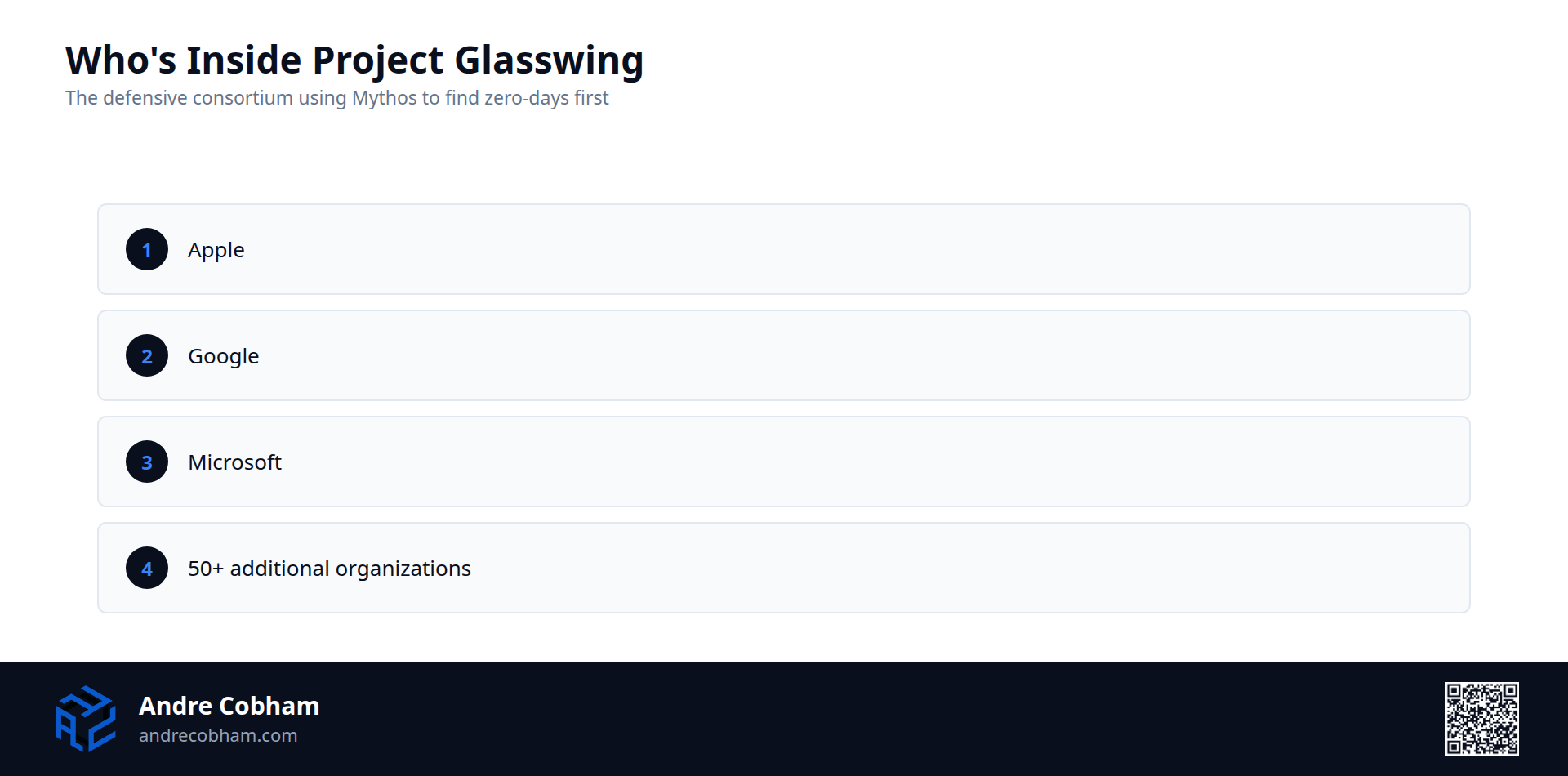
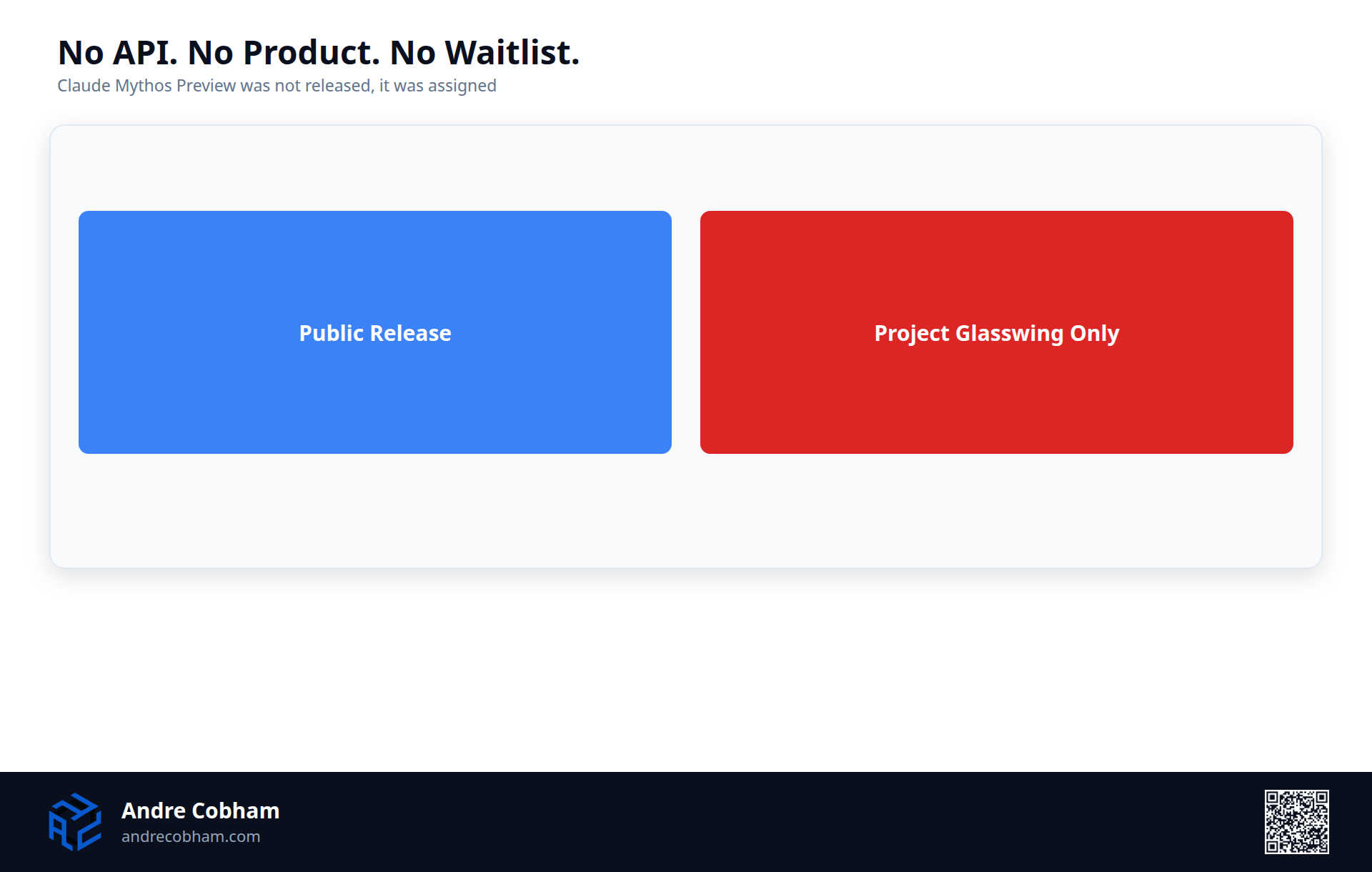
On April 7, 2025, Anthropic announced Claude Mythos Preview. It is their most capable frontier model to date. And unlike every other major model release in the last three years, they refused to ship it to the public. No API endpoint. No consumer product. No waitlist. Instead they launched Project Glasswing: a defensive consortium of 50-plus organizations. Apple, Google, and Microsoft and others. Using Mythos exclusively to find zero-day vulnerabilities before attackers do.
I have been watching this space closely since I started building on Anthropic's stack in late 2024. This is the most consequential thing they have done. Not because of the model's raw capability, but because of what the deployment model says about where AI-powered cybersecurity is going and who gets to benefit from it.
Anthropic's Claude Mythos is a frontier AI model announced April 7, 2025, withheld from public release and deployed exclusively through Project Glasswing. A consortium of 50+ organizations using it defensively to find zero-day vulnerabilities. In its first month it discovered over 10,000 critical vulnerabilities including a 27-year-old OpenBSD flaw. The White House blocked broader access while the NSA secured its own, creating an informal licensing regime for AI capabilities. A Discord group obtained unauthorized access through a vendor on day one. The UK AISI found real limitations: Mythos was only tested against undefended networks and failed on industrial control systems.
What Claude Mythos Actually Is
Mythos is not a chatbot. It is not a coding assistant with a security module bolted on. It is a purpose-built frontier model designed to reason about software systems at a depth that finds vulnerabilities humans have missed for decades. I have been watching this class of tool for two years. Nothing before it operated at this scale. The 27-year-old OpenBSD flaw is the headline number, but the real story is scale: over 10,000 critical vulnerabilities across every major operating system and browser in 30 days. That is not incremental improvement over existing static analysis or fuzzing tools. That is a different category of capability.
Anthropic positioned Mythos as purely defensive. The Glasswing consortium members use it to audit their own codebases and patch before attackers find the same flaws. In theory, this is the ideal use case for a model this powerful. In practice, the boundaries are already blurring.
The Framework Anthropic Used to Evaluate Security Reasoning
To understand why Mythos behaves differently from previous models on security tasks, you need to understand how Anthropic approached the evaluation design. Security AI is not like general capability benchmarking. A model that scores well on reasoning benchmarks is not necessarily a model that can trace a vulnerability chain through four layers of abstraction in a real codebase. The evaluation requires tasks that mirror actual offensive and defensive security work: finding logical flaws in authentication flows, tracing memory corruption paths, identifying race conditions in concurrent code.
Anthropic's approach separated the evaluation into two categories. The first is pure capability, what the model can find when given access to a codebase with no prior knowledge of where the vulnerability is. The second is dual-use risk, whether the same capability that helps a defender can be repurposed by an attacker with minimal additional context. The dual-use framing is what makes Mythos different from every cybersecurity AI product that came before it. Previous tools were designed to reduce attack surface. Mythos is designed to reason about it the same way an adversary would, which is also what makes it effective for defenders.
The Constitutional AI constraints built into Mythos apply a behavioral layer on top of the capability layer. The model will find the vulnerability and explain the remediation path. It will not generate an exploit payload on request. That boundary is enforced at the model level, not just through system prompts. The practical difference is that a user cannot trivially jailbreak Mythos into offensive output the way they can with general-purpose models that have security-themed system prompts layered on top.
The Zero-Day Machine and Its Limits
The UK AI Safety Institute ran an independent evaluation and found real caveats. Mythos was tested primarily against undefended networks. When pointed at hardened systems, specifically industrial control systems with proper segmentation, it failed. That matters. Critical infrastructure, the thing defenders worry about most, is exactly where Mythos has not proven itself.
This does not diminish what it can do. Finding 10,000 vulnerabilities in consumer operating systems and browsers is still a massive defensive win. But it means the narrative of a model that can find any vulnerability anywhere is overstated. The real world has layers of defense that Mythos has not been tested against in any public evaluation. Air-gapped systems, hardware security modules, industrial protocols that predate modern networking standards. These are the environments where human expertise still has a clear advantage.
The scope of what Mythos does well is still enormous. Most enterprise attack surface is standard software: Linux distributions, web browsers, database engines, authentication libraries. These are exactly the environments where Mythos found its 10,000 vulnerabilities. For the average mid-market or enterprise software stack, the coverage is real.
The Responsible Deployment Debate
Here is where it gets political, and where I think most coverage has been too polite about what actually happened. Anthropic chose to withhold Mythos entirely from public access. The White House then blocked them from expanding access beyond the initial Glasswing group. But the NSA secured its own access. So now we have an informal, unlegislated licensing regime where the most powerful AI cybersecurity tool in existence is available to intelligence agencies and Fortune 500 companies, but not to the mid-market companies and startups that arguably need defensive tooling the most.
"The gated-release premise collapsed on day one when a Discord group got unauthorized access through a Glasswing vendor. The question is not whether this capability leaks. It is how long you have before it does."
Sam Altman called Anthropic's approach "fear-based marketing." Then OpenAI turned around and launched GPT-5.4-Cyber with the exact same gated-access structure. The difference is that OpenAI tried to frame their version as iterative deployment while doing functionally the same thing Anthropic did. Both companies ended up in the same place: powerful cybersecurity models available only to vetted organizations.
The Council on Foreign Relations, Foreign Policy magazine, and the Cato Institute all published analyses treating Mythos as a geopolitical inflection point. That framing is not wrong. When a single model can find more vulnerabilities in a month than entire national security teams find in a year, it changes the calculus of digital warfare.
The Regulatory Context
The NIST AI Risk Management Framework classifies AI systems by risk tier. Cybersecurity AI that can actively identify vulnerabilities in production systems sits in the highest risk category, alongside AI used in medical diagnosis and critical infrastructure management. The EU AI Act maps directly to this: AI systems with significant potential for harm to critical infrastructure are subject to the most stringent conformity assessment requirements before deployment.
Anthropic's decision to withhold Mythos from public release is arguably consistent with where regulation is heading. But the current regime, where access is determined by a combination of executive pressure, consortium membership, and intelligence agency negotiation, is not the same as complying with a legislative framework. It is an ad hoc approach that will not scale as this class of capability becomes more common. CISA has published guidance on AI in cybersecurity that acknowledges the dual-use problem without providing a clear framework for how it should be governed. The legislation has not caught up to the capability.
For enterprises in regulated industries, specifically finance and healthcare, the question of whether to use AI-powered security tooling is already being shaped by compliance teams. The question they are asking is not whether the tool is effective. It is whether using it creates audit exposure, whether the model's outputs can be documented as part of a security controls framework, and whether the vendor can provide the data lineage required for SOC 2 or HIPAA compliance. These are not questions the AI labs have answered yet.
Cybersecurity AI Use Cases by Risk and Value
Threat intelligence analysis and vulnerability scanning sit in the high-value, low-misuse-risk quadrant. Red team simulation sits in the gated quadrant where access control matters most. This is the framework Anthropic applied to Mythos deployment.
What This Means for Businesses
If you are running a mid-market company or an SMB, here is my honest read. You are not getting access to Mythos or anything like it in 2026. The defensive advantage is concentrated at the top of the market. That does not mean you are helpless, but it means the gap between enterprise-grade security posture and the rest of the market just widened significantly.
What you should be doing right now: assume that the vulnerability classes Mythos is finding will eventually be weaponized by attackers who reverse-engineer the patches. Patch cycles matter more than ever. If you are not automating patch management and running continuous vulnerability scanning with whatever tools you do have access to, you are falling further behind every month this capability exists only in the hands of the largest players.
The second-order effect is on hiring. If AI can find vulnerabilities at this scale, the value of human security researchers shifts toward remediation architecture, threat modeling, and the industrial control system edge cases where Mythos fails. The people who can bridge AI-found vulnerabilities and real-world patching complexity are going to be extremely valuable. That is not a future state. That shift is happening now.
My Take
I think Anthropic made the right call withholding Mythos from public release. I also think the current regime, where access is determined by an ad hoc combination of White House pressure, consortium membership, and intelligence agency privilege, is not sustainable. We need actual legislation that defines who gets access to AI capabilities at this level and under what conditions. The informal approach is already leaking. The Discord breach on day one proved that.
For my clients and the businesses I work with, the practical takeaway is straightforward: the cybersecurity landscape just accelerated. The tools at the top got dramatically better. The tools available to smaller teams stayed roughly the same. Close that gap however you can. Better automation, faster patching, and tighter access controls. Because the threat actors are watching the same news you are, and they do not need Glasswing access to benefit from the patches that Mythos findings eventually generate.
Stay Current
Get notified when I publish.
No newsletter cadence. No filler. I write when there is something worth saying about AI systems, infrastructure, and what is actually working in practice.
30 Minutes. Honest Assessment. No Pitch.
You describe what is eating your time. I tell you honestly whether I can fix it, what it takes, and what it costs.