
I have shipped AI systems for small and mid-sized businesses since 2024, and I keep a running list of the beliefs that sink these projects before the first line of code gets written. The projects rarely fail on budget or ambition. They fail on expectation, on a claim that sounds airtight in a product demo and falls apart the moment real data hits it. Here are the five I run into most, and what each one actually costs the business that believes it.
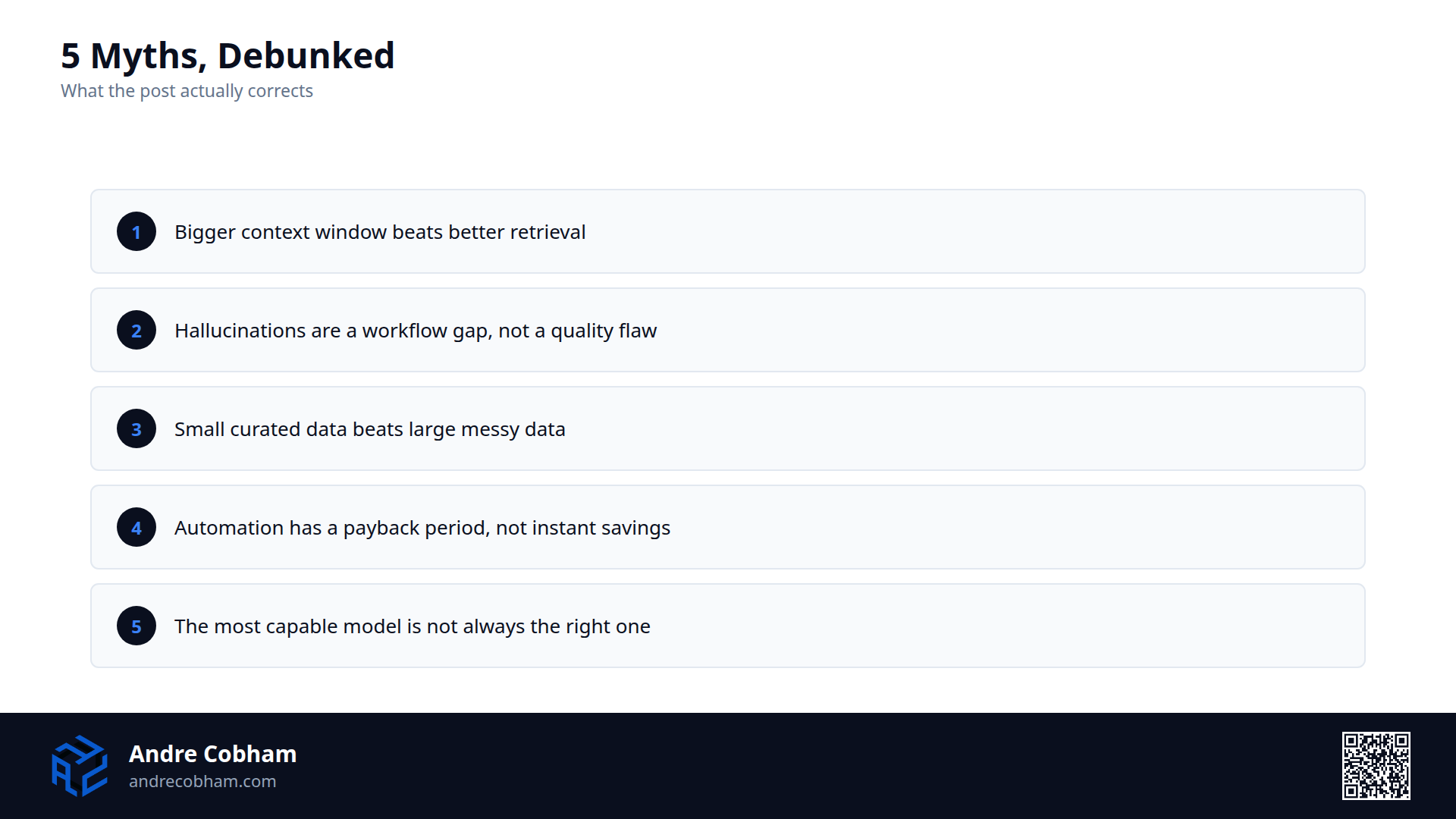
Most of what companies believe about large language models comes from vendor decks, not production runs. A bigger context window does not mean a better answer. Hallucination is structural, not a defect you buy your way out of with a model upgrade. You do not need a warehouse of data to start. Automation returns time before it returns money. And the most capable model is usually the wrong tool for routine work. Get these five wrong and you overpay for the wrong model, stall for months on a data-readiness myth, and blame the technology for a planning gap. Verdict: the technology works. The expectations around it are where the money leaks.
Where these beliefs come from
None of these myths are stupid. Each one starts from something true and stretches it one step too far. Vendors have every reason to make that stretch, because the true version does not sell as well as the inflated one. A demo runs on curated inputs, a clean question, a tidy document, a happy path chosen precisely because it works. Production runs on your actual inbox, your actual spreadsheets, and the edge cases nobody scripted. The distance between those two worlds is where most of the disappointment lives.
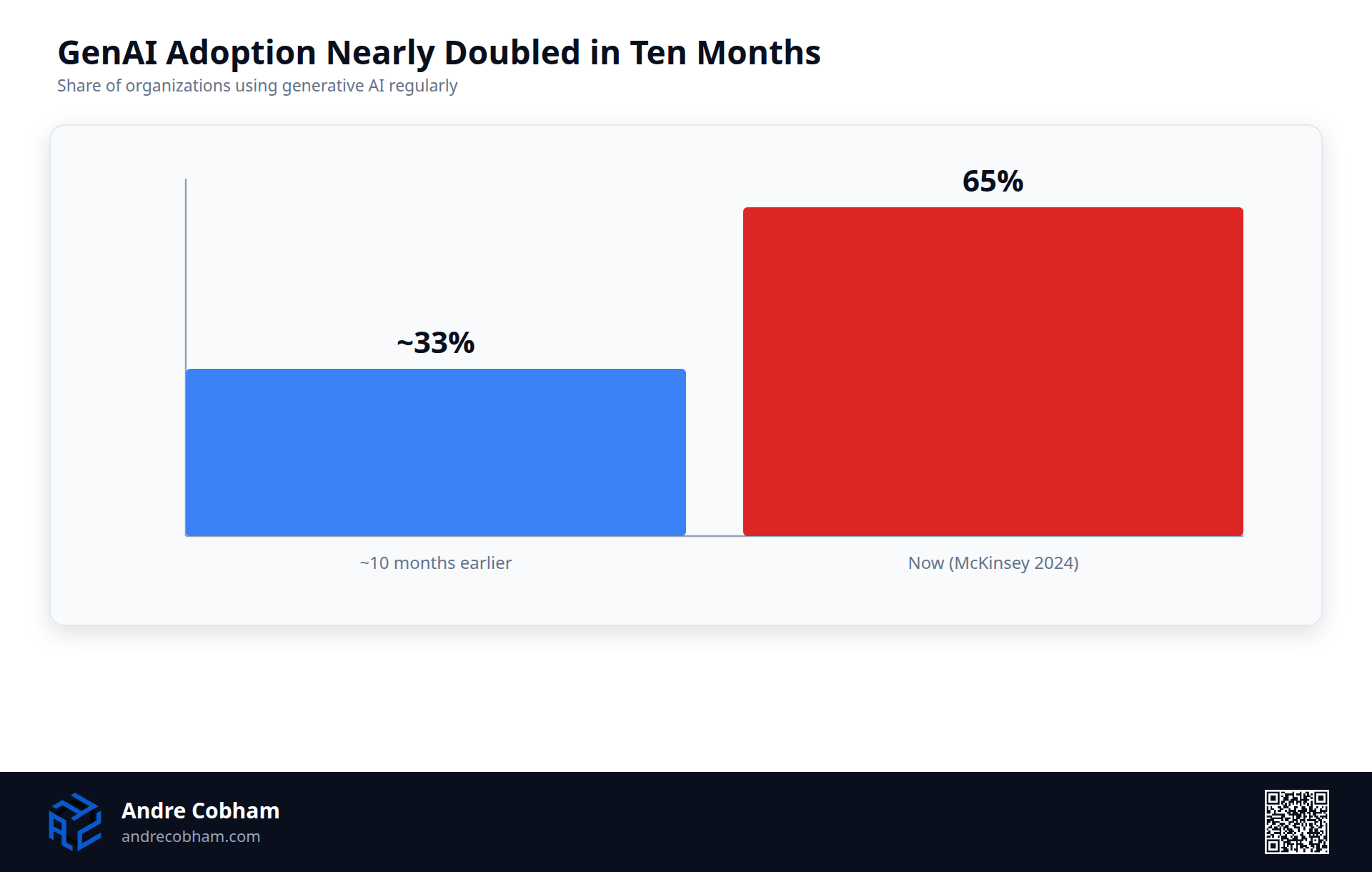
The stakes are no longer niche. McKinsey's 2024 State of AI survey found that 65 percent of organizations now use generative AI regularly, nearly double the figure from ten months earlier, with overall AI adoption at 72 percent. That means most businesses are buying, deploying, and budgeting for these systems right now, often on the strength of assumptions they have never tested. A wrong assumption at that scale is not a rounding error. It is the difference between a system that earns its keep and one that quietly bleeds money.
Myth 1. A bigger context window gives you better results
The logic feels obvious. If the model can read more of your material at once, it should produce better answers. Providers reinforce this by leading with window size as the headline spec. Google now documents Gemini models that accept past one million tokens in a single request, enough to hold entire codebases or shelves of documents. The number is real and the capability is real. The conclusion people draw from it is not.
Reading and using are not the same operation inside a transformer. Attention in a decoder-only model does not spread evenly across the input. It concentrates at the beginning and the end and thins out in the middle, and that thinning has been measured directly. Researchers at Stanford and Berkeley ran a controlled test, documented in Liu et al. (2023), that placed the document containing the answer at different positions inside a long context. When the answer sat first or last, models found it. When it sat in the middle, GPT-3.5-Turbo's accuracy fell more than 20 percentage points, dropping below its own closed-book baseline. The model did worse with the relevant document present than it would have with no document at all.
A one-million-token window does not hand you one million tokens of equal utility. It hands you strong attention at the edges and weak attention through the vast middle, and the more you stuff in, the more your important material risks landing in the dead zone. Bigger windows solve a capacity problem, not a comprehension problem, and treating capacity as comprehension is how a retrieval system that worked at ten documents starts missing obvious answers at two hundred.
The fix is not a larger window. It is deliberate ordering. Put the single most relevant document first, put the second most relevant last, and cap retrieved context at roughly 15 to 20 documents so nothing critical drowns in the middle. Position is an engineering decision with a measurable effect on accuracy. Treat it like one.
Myth 2. Hallucinations are a model quality problem
When a model invents a fact in production, the reflex is to reach for a better model. Sometimes the upgrade lowers the frequency, which reinforces the belief that hallucination is a quality dial you can turn down by spending more. It is not a dial. It is a property of the machine.
A language model predicts the most statistically likely next token given everything it has seen. It carries no internal signal for truth and no built-in sense of its own uncertainty. It does not know when it does not know. It generates fluent, confident text whether the underlying claim is accurate or fabricated, because fluency and accuracy are separate properties that merely correlate in training data. When they diverge, the model has no mechanism that notices. It keeps producing polished sentences at the same confidence level it uses for facts it has right.
Better models hallucinate less often. They do not hallucinate never. The gap between a frontier model and a mid-tier one is a lower probability of fabrication, not a guarantee against it, and a lower probability is not a safe foundation for a workflow that touches invoices, contracts, or medical intake. I have watched teams burn a quarter chasing the next model release, convinced the fabrications would vanish at the next tier. They never fully did.
The intervention that works is architectural, not a purchase. Ground the model in retrieved source documents before it generates, so the answer is anchored to real text instead of the model's memory. Constrain the output with a schema, so the shape of the response is fixed and checkable. Add a validation layer that verifies claims against a known-good source before anything reaches a user. These change the conditions under which generation happens, which is the only lever that actually moves hallucination risk in production. The model doing the generating stays the same. The system around it stops trusting the model blindly.
Myth 3. You need a large dataset to build an AI workflow
Teams stall for months because they believe their data is not ready. Too small, too messy, not enough volume to feed the machine. Some of that caution is legitimate. Most of it comes from confusing two different things, training a model and retrieving from your data, and assuming the first one applies when the task only needs the second.
A retrieval-augmented system can run on 50 well-structured documents. The model does not memorize your business. It finds the relevant passage at the moment of a query and reasons from what it retrieves. That is a retrieval and structuring problem, and retrieval problems do not scale with raw volume the way training does. You are not teaching the model your data. You are giving it a well-organized shelf to pull from on demand.
What I see over and over in practice is that 200 clean records in a consistent schema outperform 50,000 messy ones in a flat export. The model cannot compensate for disorganized source material. It amplifies whatever structure exists, so inconsistent inputs produce inconsistent outputs at scale, and now you have automated the mess instead of fixing it. Volume without structure just makes the retrieval step guess more.
So the question to ask before an AI project is not whether you have enough data. It is whether your data is organized well enough to retrieve accurately. That is a smaller, sharper problem than the one most teams talk themselves into, and it is usually solvable in weeks. Waiting to accumulate more data before you start is often waiting for the wrong thing.
Myth 4. AI automation saves money immediately
This is the myth that causes the most quiet disappointment, because the timeline in the vendor deck is right while the mechanism is wrong. The savings do not arrive on the schedule everyone imagines, and when they fail to show up on time, the whole project gets labeled a miss.
Automation saves time first. Money comes later, and only from what you do with the recovered time. A workflow that returns 15 staff hours a week does not post itself as a line-item cost reduction. Those hours become capacity, and capacity turns into money only when you redirect it somewhere that earns revenue or removes a different cost. Most vendor ROI projections skip that step. They assume recovered hours convert straight into profit, which is a modeling shortcut that quietly rewrites how businesses actually work.
The teams that see fast return are the ones that had the follow-on plan ready before they automated. A sales motion waiting to absorb the freed hours. A service line the team had no capacity for until now. A client base that grows because response times finally dropped. In every one of those cases the automation was the enabler and the plan was the return. The teams that saw nothing freed the hours and let them evaporate back into the churn of the week.
So the question to settle before you build is not how many hours the system will save. It is what the business will do with the hours it returns. The answer to that question decides whether the investment pays off. The automation on its own never does.
Myth 5. The most capable model is the right model for your stack
Frontier benchmarks measure performance on hard reasoning, complex code generation, and multi-step analysis. That is what the leaderboards rank and what the launch posts celebrate, so it becomes the yardstick everyone reaches for. The trouble is that almost no business workflow is a hard reasoning task. Most are classification, extraction, summarization, and structured response generation, the kind of work where a well-prompted small model matches the flagship at a fraction of the price.
The cost difference is not marginal. It compounds every single call. Published pricing makes the gap concrete. On OpenAI's list rates, a flagship model runs around 30 dollars per million output tokens while a small model runs closer to 1.25 dollars, a 24-fold spread for the same token. Google's Gemini pricing shows the same shape, with the Flash tier at 2.50 dollars per million output tokens against 12 dollars for the Pro tier. Choosing the flagship for routine work means paying a reasoning premium on tasks that never use the reasoning.
Put real volume behind it. A classification workflow handling 100,000 calls a month, roughly 1,000 input and 200 output tokens each, costs about 1,100 dollars a month on a flagship model and about 45 dollars a month on a small one. That is 13,200 dollars a year against 540, a gap near 12,600 dollars, for a task where the two models produce the same labels. That difference is real budget, enough to fund the next AI project outright or to hire against.
Model selection should start with the task, not the leaderboard. What is the input, what is the required output, how much latency is acceptable, what is the cost ceiling. Those answers point to a model tier. A flagship's capability ceiling matters only when you operate near it, and most production workflows never come close. Use the smallest model that clears your quality bar reliably, then measure it against the task rather than the benchmark. That discipline keeps AI infrastructure cost from outrunning the value it produces.
What to actually do instead
The five myths share a cure. Design from the task backward and refuse to trust any property of the model that you have not verified on your own inputs. That single habit disarms most of the failures I get called in to fix.
Start every project by writing the output contract. Name the exact input, the exact shape of the response, and the quality bar a human would accept. That contract tells you which model tier you need and how to structure retrieval, all before you spend a dollar on the wrong assumption. Then ground everything that touches facts. Ungrounded generation is fine for drafting, reckless for anything a customer or a regulator will read.
Structure your data before you chase more of it, since fifty clean records beat a data lake you cannot retrieve from. Pick the smallest model that clears the bar, then hold it to the task with real examples from your business, not the vendor's curated demo set. And write the plan for the recovered time before you automate, because time you do not redirect is time you do not monetize.
None of this is exotic. It is ordinary engineering discipline applied to a technology that sells itself as magic. Treat it as engineering and you get a system that works. Treat it as magic and you get a bill.
My Take
Small and mid-sized businesses waste money in the same three places, every time. They pay flagship prices for classification a small model does for pennies. They stall for months waiting for their data to be ready when the real fix is a week of structuring. And they buy automation without a plan for the hours it frees, then wonder why the savings never landed. Each is a decision made before the build, and each is reversible with one honest conversation up front.
Where AI actually pays is narrower and more reliable than the hype suggests, which is exactly why it works. It pays when a repeatable, well-defined task gets grounded in clean source data, handed to a right-sized model, wrapped in validation, and connected to a plan for the capacity it returns. That is not a moonshot. It is a well-scoped first project that earns trust and funds the second. I would rather ship that than sell a client a frontier model they use at five percent of its ceiling and pay for at full price.
The technology is ready for far more than most businesses are using it for. The bottleneck is not the model. It is the expectations we bring to it, and those we can fix in an afternoon.
If you are building something and are not sure which of these myths is quietly shaping your stack, that is worth 30 minutes. Book a call and we will work through it against your actual workflow, data, and numbers.
Note: the expanded body is saved at `/mnt/local-home/sirdrez-backup/arisingmedia-websites/andrecobham-live.com/.planning/_five_myths_body.html`. I did not write it to `blog.db` (target slug `five-myths-about-llms`), since the task scoped the DB read as read-only and did not authorize a DB write. If you want it published, the next step is an UPDATE of `posts.body_html` for that slug followed by a rebuild.