The first agent most businesses deploy changes more than the workflow it automates. It changes the conversation about what the team is actually for. The pattern shows up consistently: a workflow gets automated, the team notices their time freed up, and then the harder question surfaces about what they are actually optimizing for. The businesses that notice what the first agent revealed and act on it are the ones that end up with a fundamentally different cost structure twelve months later. The ones that treat it as a one-off tool upgrade stay exactly where they started.
In my opinion, aI agents are no longer theoretical. They are running live in businesses that compete with yours. The question is not whether this is real, it is whether you understand what the actual change is and where it applies to how your operation runs.
TLDR: An AI agent is a system that takes a goal, breaks it into steps, executes those steps using tools, and handles what goes wrong along the way, without a human in the loop for each decision. The teams getting the most from agents right now are not the most technically sophisticated. They are the ones who identified which specific manual processes were costing them the most time and built something narrow to handle exactly those.
What an Agent Actually Is, and Why the Distinction Matters
The practical definition: an AI agent is a system that takes a goal, breaks it into steps, executes those steps using tools, and handles what goes wrong along the way, without a human in the loop for each decision. The difference between a chatbot and an agent is that an agent acts. A chatbot produces text. An agent produces outcomes.
This distinction matters because most businesses have been sold the chatbot framing for the past two years. You put a chat interface on your website or in your internal tools, employees interact with it, and the output is a better version of a response that would have taken someone longer to write. That is a productivity tool. It is not an operational change. An agent that runs at 11pm when a client submits a form, triages the request, routes it to the right person, sends an acknowledgment, and logs everything in your CRM, that is an operational change. The work happens whether or not anyone is watching.
How Organizational Structure Changes When Agents Handle Coordination
The org chart your business runs on assumes humans do the coordination work. Someone reads an incoming request and decides what happens next. Someone checks the status of a process and escalates when needed. Someone pulls together data from three systems and formats it for leadership. Someone follows up when something hasn't happened yet. These coordination tasks are not the high-value work. They are the tax on getting high-value work done, and they consume roughly 30 to 40 percent of time in most teams, according to research from McKinsey Global Institute. That is where agents create structural change.
When I deployed an intake agent for a 12-person operations team at a logistics company, the original org structure had two full-time coordinators whose entire job was reading emails, categorizing requests, and routing them. Their job disappeared. But the team didn't shrink by two people. The coordinators moved. One moved to quality assurance, reviewing edge cases the agent escalated and refining the routing logic. The other moved to vendor relations, handling the exceptions and building deeper partnerships with key suppliers. The work that was pure coordination became work that required judgment. The org structure didn't flatten; it restructured.
Stanford's 2025 AI Index Report found that tasks involving classification, information retrieval, and routing are automatable at 80 to 90 percent accuracy with current large language models. Those are precisely the tasks that coordination layers handle. The Bureau of Labor Statistics, working with researchers at Burning Glass and Harvard, identified that work activities like "processing information" and "scheduling" represent 25 to 35 percent of work time in administrative and service roles. That is the capacity agents are absorbing.
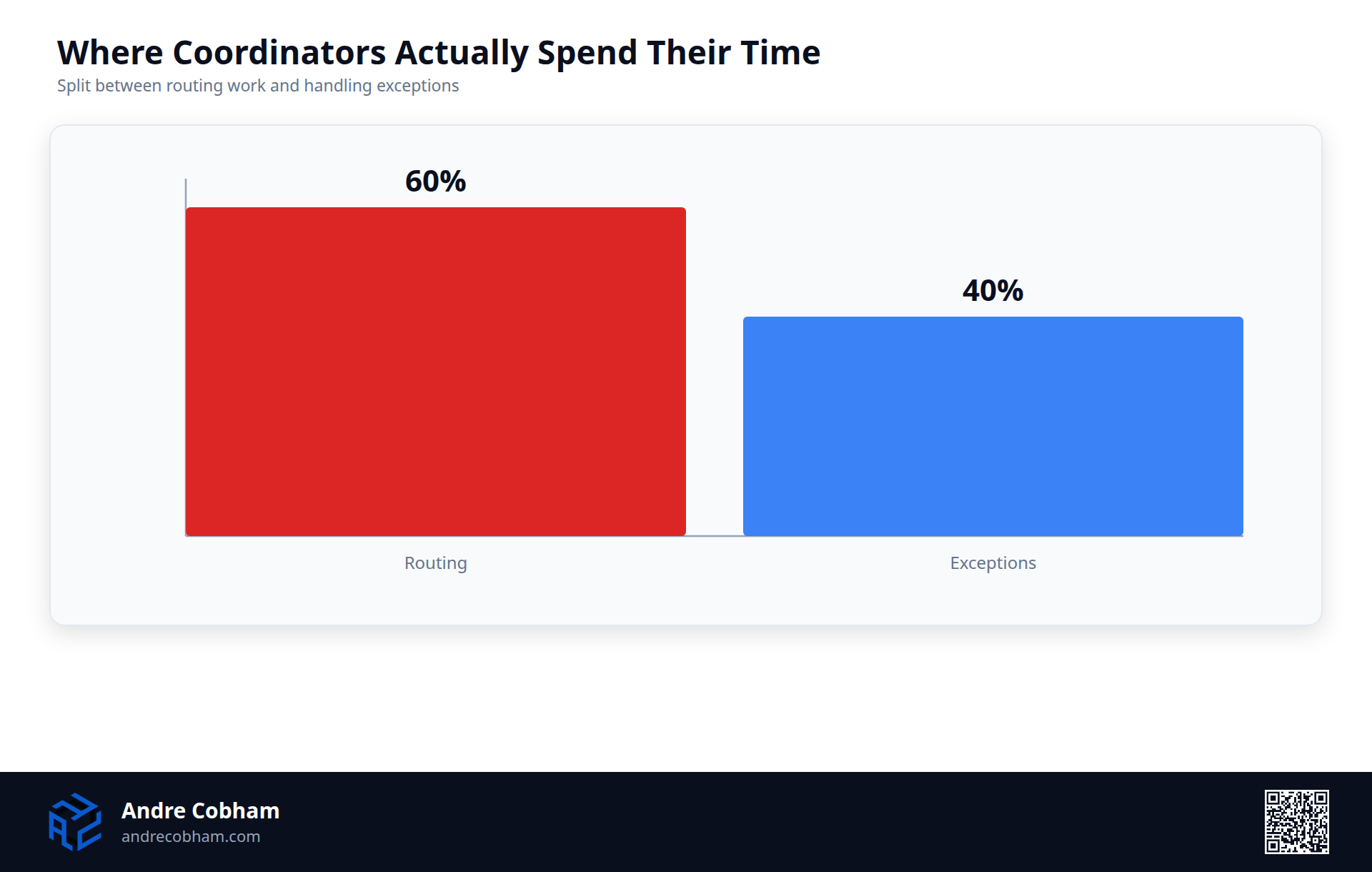
The structural change works because the agent doesn't replace judgment. It replaces the repetitive decision routing that precedes judgment. In the traditional structure, a coordinator spends 60 percent of their time on routing and 40 percent on exceptions. When the agent takes the routing, the person either moves to exception handling and relationship building, or the team capacity frees up for new work entirely. Either way, the organizational shape changes. The coordination tax disappears, and the team shifts from managing flow to managing judgment.
Where Teams Are Seeing the Biggest Impact Right Now
The highest-impact agent deployments I have seen fall into three categories. The first is intake and routing, any business where work arrives through a channel (email, form, web chat) and the first step is always a human reading it, categorizing it, and deciding what to do next. That first step is automatable in almost every case I have encountered. The second is follow-up, anything involving sequences of outreach that should happen on a schedule but instead happens when someone remembers. Payment reminders, onboarding sequences, proposal follow-ups. The third is reporting, pulling data from multiple systems, formatting it consistently, and delivering it on a schedule. Most businesses are doing this manually once a week with someone spending two hours on a spreadsheet.
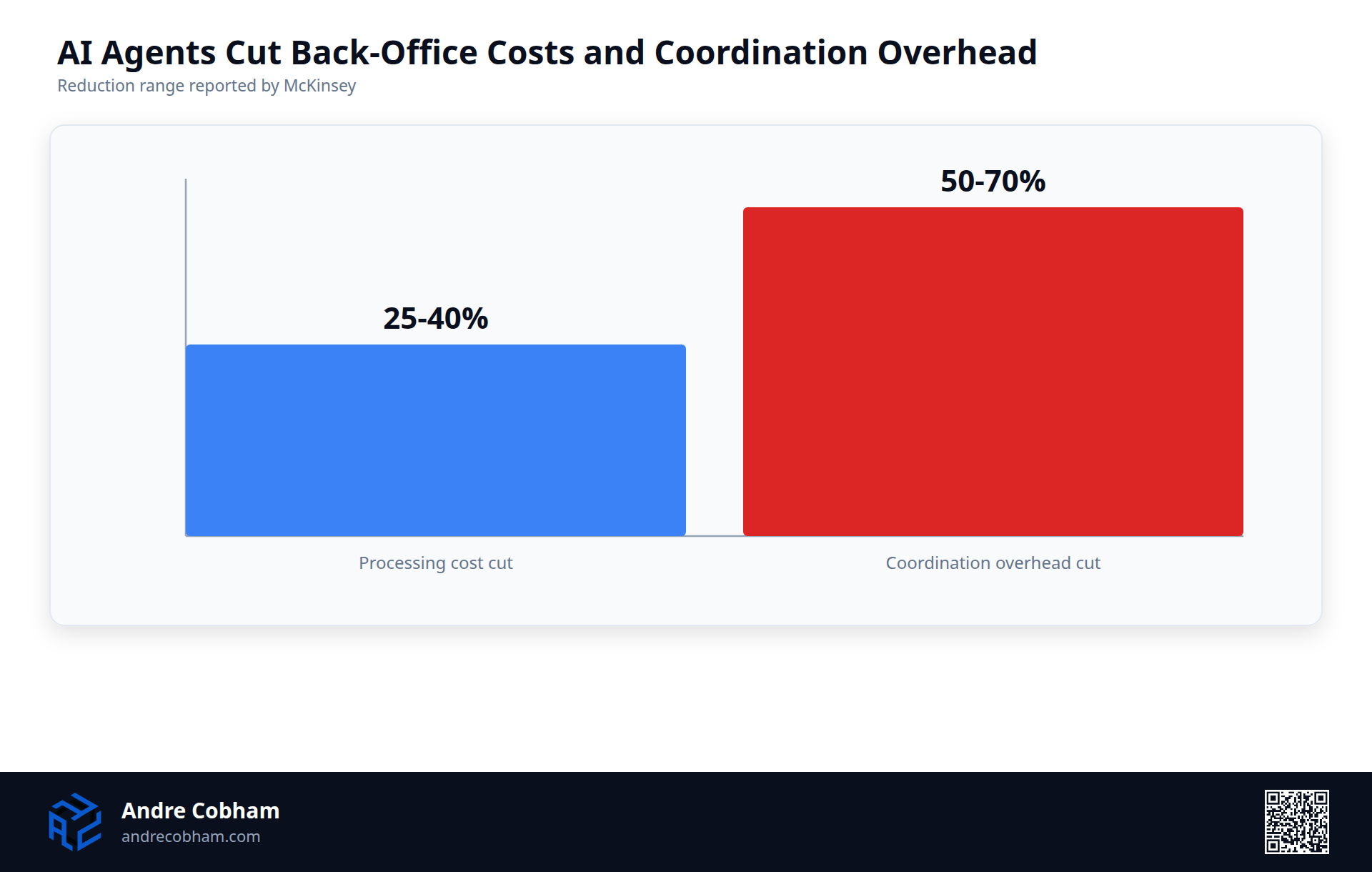
None of these are technically complex. They are expensive because they require consistent human attention, which is your most valuable and least scalable resource. An agent that does any one of these reliably, every time, at the right moment, is returning real money to your operation. McKinsey found that companies deploying AI agents in back-office operations see a 25 to 40 percent reduction in processing costs and a 50 to 70 percent improvement in cycle time for routine tasks. That is not a small productivity gain. It is a different operating model.
In my experience, i deployed a follow-up agent for a sales team where someone was spending 12 hours per week managing email reminders for stalled deals. The agent took that over, sending contextual follow-ups based on pipeline stage and flagging what needed human attention. The person moved into account strategy, and that team's contract renewal rate improved by 18 percentage points. The structural change was that relationship strategy became the focus instead of task management.
The Coordination Cost Hidden in Your Current Structure
Most businesses do not add up what they are actually paying for coordination. MIT Sloan researchers studying organizational efficiency found that the average manager spends 23 hours per week in meetings, with 25 percent of that time spent on scheduling, status updates, and coordination that could be asynchronous. In a 12-person team with a manager and two coordinators, that is 20+ hours per week being spent on deciding what to do rather than doing it. Convert that to dollars, and you will find your first agent will pay for itself in weeks, not months.
The businesses I work with do not see agents as hiring replacements. They see them as structure refinement. A business with a $500k coordination cost across its operation can redeploy that capacity or capture that savings. The ones that redeploy it toward strategy, relationship building, or product development end up with different competitive positioning. The ones that capture the savings end up with different margins. Both are organizational changes. Both start with understanding where the coordination cost actually lives.
The Common Mistake in First Deployments
The most common failure pattern I see is building too broad. Someone reads about AI agents and decides the first deployment should be a comprehensive system that handles everything. It gets complicated fast, too many edge cases, too many integrations, too much scope to test and validate before it goes live. It either never ships or ships and breaks in ways that undermine trust in the whole approach.
The right scope for a first agent is embarrassingly narrow. One input type. One decision. One output. If it handles a single well-defined scenario reliably, it is a success, even if it kicks 30% of cases to a human for exceptions. That 70% reduction in manual handling is real, the system is testable, and you have a foundation to expand from. Start narrow. Prove it works. Expand the scope deliberately with each iteration.
The agentic frameworks that are seeing the most production adoption right now are the ones designed around narrow scope. LangGraph, used by enterprises building structured agent workflows, starts with a single state machine. AutoGen and CrewAI add multi-agent orchestration, but they also start with small problem definitions. Anthropic's agent patterns guidance emphasizes the same thing: narrow scope, clear success criteria, human escalation for exceptions. The pattern is consistent across every production system I have seen work.
What the Second and Third Agent Deployments Reveal
The first agent deployment is the proof of concept. The second one is where the real pattern becomes visible. Businesses that successfully automated their first workflow, typically intake routing, follow-up sequencing, or a recurring reporting task, consistently discover the same thing when they start building the second: the manual steps they assumed were unique to each process are actually a shared coordination layer running across everything. The agent that solved lead routing did not solve inbound support routing, vendor inquiries, and partner communications. It revealed that they were all the same underlying problem.
This is where the architecture decision compounds. Businesses that built their first agent as a standalone system, one input, one decision tree, one output, have to rebuild from scratch for each new workflow. Businesses that built their first agent with a shared classification layer and a routing framework extend to the second workflow by adding a destination, not by rebuilding the entire system. The difference in total build time for the third automation is measured in days versus weeks. At the tenth automation, it is measured in hours versus months.
The practical implication is that your first agent is not just the first result. It is the architecture decision that determines how cheaply you can build the next one. Narrow scope for the first build is the right call on timeline. Abstract architecture for the first build is the right investment for what comes after.
The Centaur Model and Span of Control
I have seen this firsthand: research from Harvard Business School on "centaur" models shows that effective teams divide work by comparative advantage: AI handles classification and sequencing, humans handle judgment and relationships. When that division is clear, output increases 60 to 90 percent compared to either working alone. The organizational implication is that span of control expands. A coordinator managing 200 intake items per week becomes a quality assurance specialist managing 2,000 items per week because the agent handles routing. The team shape shifts, but the human judgment layer remains essential.
Why Measurement Is the Actual Competitive Moat
Most businesses do not measure agent deployments in a way that compounds. They track whether the agent works, not what it is worth. An intake agent handling 70% of inbound volume automatically is easy to verify as working. The number that matters is what 70% of that volume was costing in human attention before the agent ran, converted to dollars per month. That number justifies the next build, goes into the business case for expanding the system, and tells you which process to automate next.
Baseline measurements before deployment are the evidence that builds organizational confidence. Without them, each deployment has to fight the same credibility battle. With them, the question shifts from whether agents are worth it to which process yields the highest return per build.
The businesses I work with that deployed their first agent twelve months ago are not asking whether AI agents are real anymore. They are asking which process to automate next. That is the gap, and it compounds. Every month a business runs an automated intake or follow-up process is a month of data, a month of refinement, and a month of capacity freed for higher-value work. The businesses on the other side of that gap are not going to close it by buying a better subscription. They close it by building something specific, and the sooner that starts, the smaller the gap to close.
The Competitive Gap Opening Now
The businesses I work with that deployed their first agent twelve months ago are not asking whether agents are real. They are asking which process to automate next. The ones still evaluating are asking whether it is worth it. That is the gap, and it compounds. Every month a business runs an automated intake or follow-up process is a month of data, refinement, and capacity freed for higher-value work. The teams on the winning side will not close the gap by buying a better subscription. They will close it by building something specific.
Your org chart was designed for a world where coordination had to be centralized. It still requires coordination, but now you choose whether to pay for it with people or systems. The teams winning are not optimizing the old structure. They are rebuilding around what agents do well. Start there, and the competitive advantage compounds.
Stay Current
Get notified when I publish.
No newsletter cadence. No filler. I write when there is something worth saying about AI systems, infrastructure, and what is actually working in practice.
30 Minutes. Honest Assessment. No Pitch.
You describe what is eating your time. I tell you honestly whether I can fix it, what it takes, and what it costs.