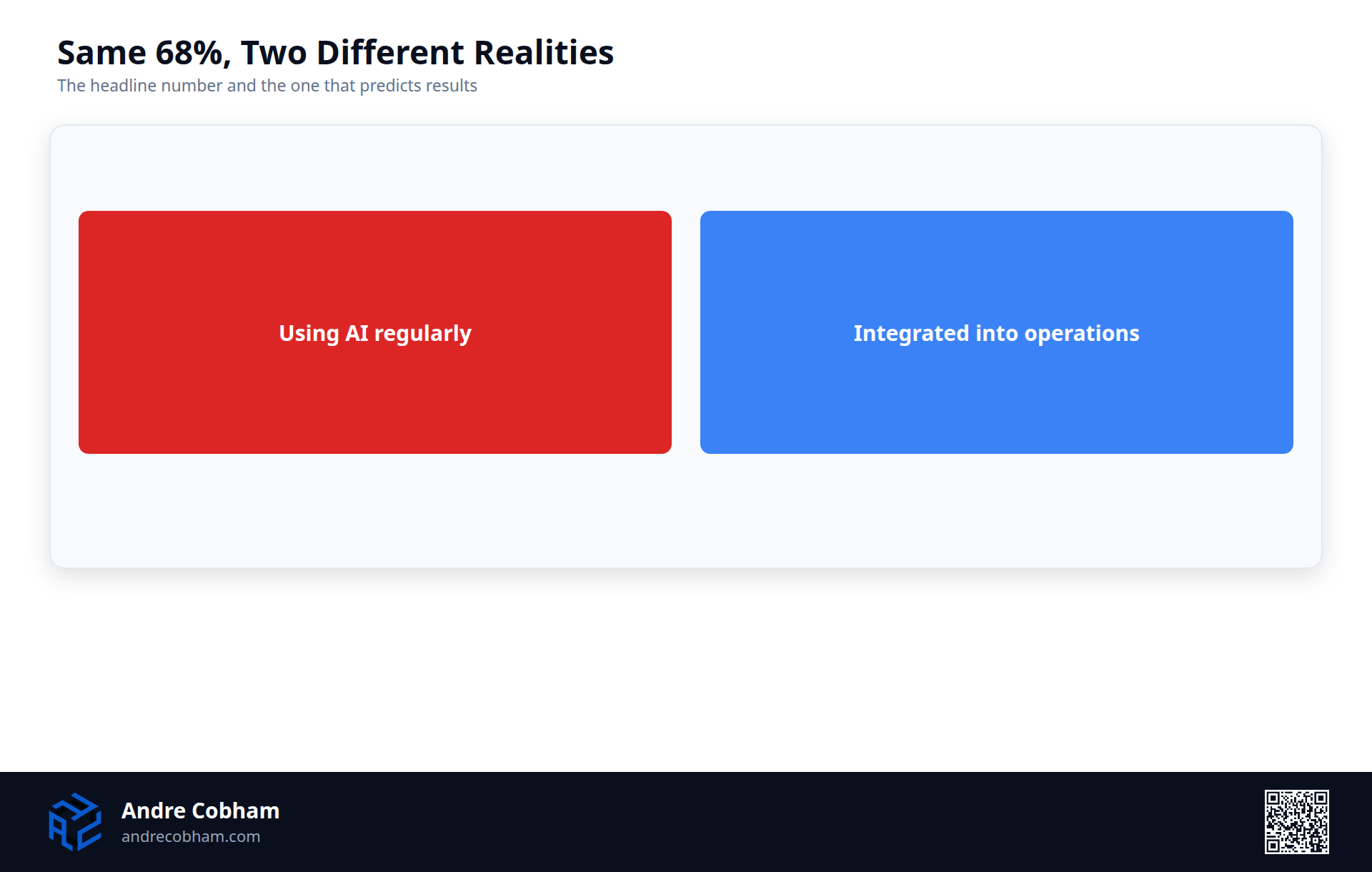
Three separate announcements landed this week from OpenAI, ServiceNow, and new survey data showing 68% of U.S. small businesses are using AI regularly, up from 48% just eighteen months ago. The thread connecting all three: the tools moved from suggesting to acting, and the businesses that figured that out first are already running a different operation than the ones still in pilot mode.
But 68% using AI regularly and 68% having integrated AI into operations are not the same number. The survey question matters. When I look at what clients across different sectors are actually doing with AI, the distribution is not a bell curve. It is two peaks with a gap between them that is widening every quarter.
What "Using AI" Actually Means in the Survey Data
The U.S. Chamber of Commerce Small Business AI survey and SCORE's AI adoption research both use "using AI regularly" as a category that includes businesses that open ChatGPT once a week to rewrite a social media caption alongside businesses that have automated their entire client intake and proposal pipeline. Those are not comparable operations.
The 68% figure is real and it is meaningful as a cultural marker. It tells you that AI has crossed the awareness threshold for the majority of small business owners. They have an account somewhere. They have tried something. That is genuinely different from where this market was 24 months ago. But awareness and integration are separated by a large gap in practice, and that gap is where the competitive divide is forming.
The businesses in the top tier of that 68% are not using AI more often. They are using it differently. The distinction is not frequency of use. It is whether AI is in the workflow or adjacent to it. Sending a document to ChatGPT and then copying the result back into your CRM is adjacent. Having the AI operate the CRM directly based on structured inputs from a form submission is integration. The time savings are not comparable and neither are the compounding effects over 18 months.
The Two Tiers That Are Emerging
The first tier has AI embedded in core business processes. Client intake is automated. Follow-up sequences run without manual triggers. Proposals are drafted from structured data. Reporting that used to require a staff member pulling data from three systems is now a scheduled job. These businesses did not necessarily hire a developer. Many of them used Zapier with AI actions, Make.com automations, or native AI features in tools they already subscribed to. The integration happened in 90-day sprints, usually starting with the highest-volume, most repetitive task in the operation.
The second tier is running experiments. They have tried AI for writing and maybe for customer service chat. They have not connected it to any system that makes a business decision. The AI is an assistant that they query and then decide what to do with manually. There is nothing wrong with this as a starting point. The problem is that the starting point has not changed in 18 months for a significant portion of this group, while the tools available to them have gotten dramatically more capable.
The McKinsey State of AI 2024 report identified a similar bifurcation at the enterprise level, where a small percentage of organizations described as AI high performers were capturing a disproportionate share of productivity and cost reduction gains. The same pattern is repeating at SMB scale, on a compressed timeline because the tools are easier to deploy and the operational surface area is smaller.
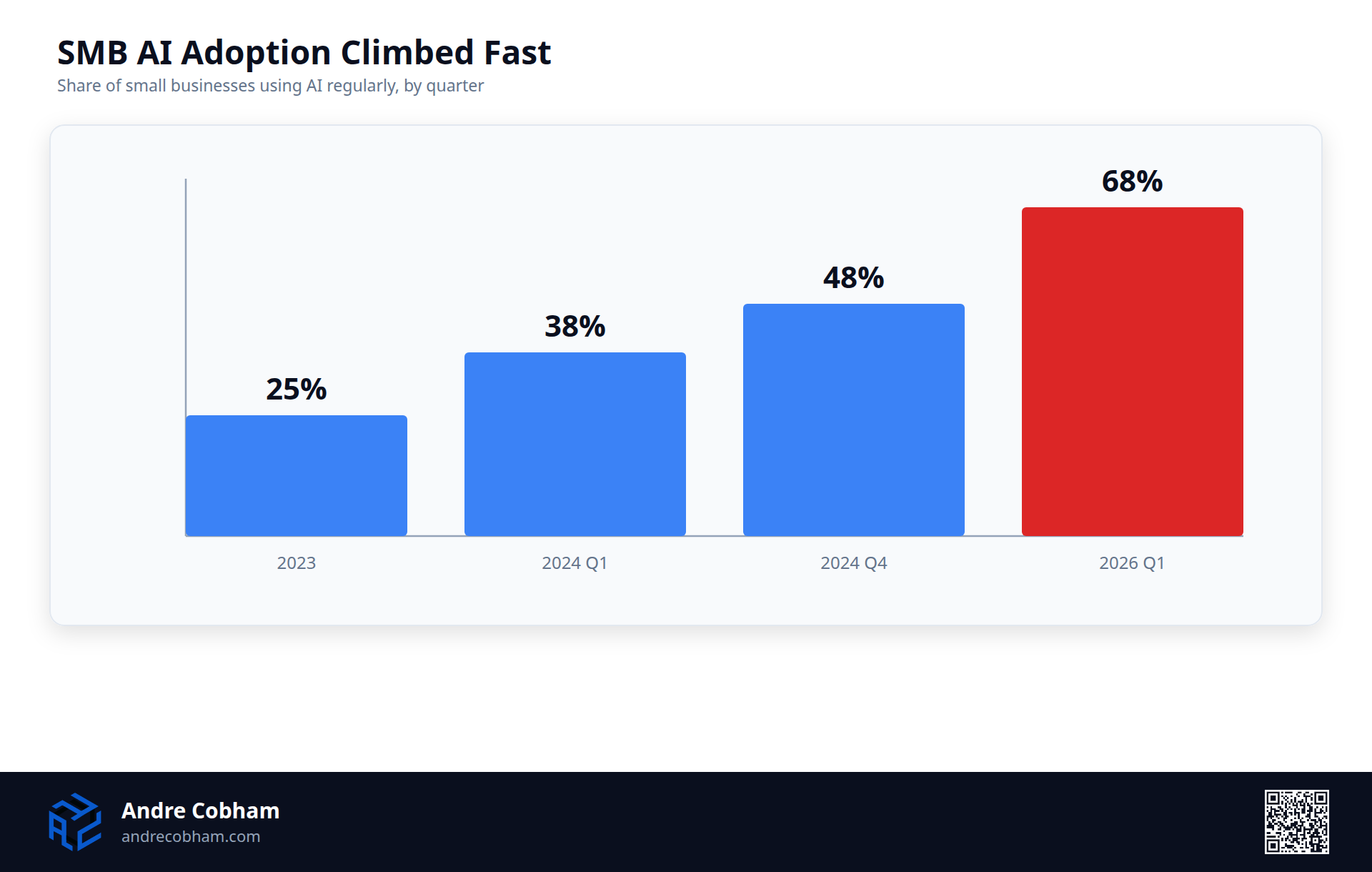
SMB AI Adoption Rate Over Time
I have seen this firsthand: u.S. SMB regular AI usage rose from 25% in 2023 to 68% in 2026 Q1. Sources: U.S. Chamber of Commerce Small Business AI survey, SCORE AI adoption research.
What the Leading SMBs Are Actually Running
Across client work over the past year, the businesses that have crossed from adjacent to integrated are running a small set of tools in combination. ChatGPT for Business provides the AI layer for customer-facing tasks and internal document drafting. Zapier with AI actions connects that layer to the CRM, the scheduling system, and the email platform. HubSpot's native AI features handle lead scoring and sequence personalization for clients on that CRM. The common thread is that none of these required a developer for the initial integration. They required someone willing to spend four to six weeks configuring and testing.
The laggards are using the same tools, just differently. They have ChatGPT open in a browser tab. They paste things into it and copy results out. That is a personal productivity tool, not a business operation change. The gap is not about tool access. It is about whether the AI output connects to a system that records and acts on it, or whether it goes through a human's clipboard each time.
ServiceNow Now Assist and the Default-On Shift
ServiceNow's Now Assist, built into their platform for IT service management, HR, and customer service workflows, represents a different kind of adoption pressure. When the enterprise software that an SMB's IT provider runs becomes AI-enabled by default, the SMB encounters AI in their operations without necessarily choosing to deploy it. The AI is now doing triage, suggesting responses, and summarizing tickets inside the toolchain that their managed service provider uses on their behalf.
This default-on pattern is accelerating across the software layer. Microsoft 365 Copilot for Business, HubSpot AI, QuickBooks AI categorization, and Salesforce Einstein are all embedding AI into products that SMBs already subscribe to. The adoption curve in the survey data is partly a reflection of AI becoming ambient in the tools the market already uses, not just an increase in deliberate AI deployment decisions.
The implication for SMBs is that doing nothing is now an active choice that has costs. If your CRM is generating AI-powered lead scores and you are ignoring them in favor of manual review, you are absorbing the subscription cost of the AI feature without getting the operational benefit. The businesses winning in this environment are the ones who learn what their existing tools can do automatically and configure them, rather than waiting for the need to feel urgent enough to justify action.
The Compounding Effect and What 2.5 Years of Process Data Means
The most underappreciated aspect of early integration is the data compounding effect. Businesses that started building AI-assisted workflows in 2023 now have 2.5 years of structured interaction data, outcome records, and process iteration history. Their AI systems have been tuned against real results. Their teams know what the AI gets right and what needs human review because they have run thousands of actual cases through it.
A business starting today with the same tools gets the same starting capability. But they do not get those 2.5 years of calibration. They start with generic prompts and generic configurations and spend their first six months learning what the early movers learned in 2023. The gap is not insurmountable. But it is real, and it grows each quarter that passes.
Goldman Sachs research published in 2024 on AI and productivity estimated that AI adoption in services businesses could increase output per employee by 15-30% for tasks amenable to AI assistance. The wide range in that estimate reflects the difference between businesses that use AI as a query tool and businesses that have embedded it in repeatable workflows. The compounding effect of the latter over 24 months is substantial in cumulative staff-hour savings and in the operational capacity it creates to take on more clients without proportional headcount growth.
A Realistic 90-Day AI Integration Roadmap for a Small Service Business
From my perspective, the 90-day frame is deliberate. It is long enough to get through the learning curve on one workflow, validate it against real results, and build confidence for the next. Trying to integrate AI across the entire operation in 30 days produces surface-level deployments that do not stick. Waiting indefinitely for the perfect moment means perpetually trailing the businesses that started with imperfect implementations and improved them.
Days 1-30: Pick the single highest-volume repetitive task that currently requires a human to read information and type a response or record. For most small service businesses this is client intake, follow-up emails, or meeting summary capture. Connect your existing tool to a Zapier workflow with an AI action. Test it against real inputs for four weeks without changing the human review step. Learn what the AI gets right and what it gets wrong on your specific volume of real cases.
Days 31-60: Based on what you learned, tune the prompt, the trigger conditions, or the output format. Identify which outputs need human review and which can route directly. Remove the human from the loop on the ones that proved reliable. This is the step I see most businesses skip, which is why their AI deployment stays in pilot mode indefinitely. Removing the human from the reliable cases is what creates the operational capacity gain.
Days 61-90: Measure the hours saved. Pick the second workflow. Repeat. By day 90 you have one working, human-free AI workflow and a second one in its first 30 days of testing. You also have internal knowledge about how AI performs on your specific business inputs that did not exist before you started. That knowledge is the foundation everything else builds on.
The 68% adoption number will keep climbing. The competitive gap it obscures will also keep widening, because the metric that matters is not whether you have used AI but whether it is doing work in your operation right now, while you are doing something else.
What I See Differently Working Across Multiple Clients
Working across clients in professional services, e-commerce, and consulting over the past 18 months, the divide between tier one and tier two SMBs is visible within a single conversation. Tier one clients come to new projects with a list of what their current automations already handle. Tier two clients describe what they want AI to do and then list the manual steps they currently perform to get to the same outcome. The difference is not intelligence or technical sophistication. It is whether they made the decision to remove themselves from a process step and actually did it.
The most common blocker I encounter for tier two clients is not capability, it is trust calibration. They tried AI for a task, it produced something that needed editing, and they concluded that AI is not reliable enough to run without review on every output. That conclusion is often correct for the first month of deployment on any new task. It becomes incorrect after the prompt and the workflow are tuned against real results. The businesses that pushed through the calibration period are the ones operating autonomously. The ones that stopped after the first imperfect output are reviewing every AI output manually, which is slower than not using AI at all when the review adds more time than the generation saved.
The Zapier state of automation report for 2024 showed that SMBs running five or more automations had significantly higher reported productivity gains than those running one or two. That is a compounding curve, not a linear one. The value of each additional automation is higher because it connects to workflows that existing automations already handle. A business with a working intake automation gets more value from a follow-up automation than a business starting from scratch, because the handoff between them is already structured. Building the first automation is the hardest step. Every subsequent one builds on the foundation the first one created.