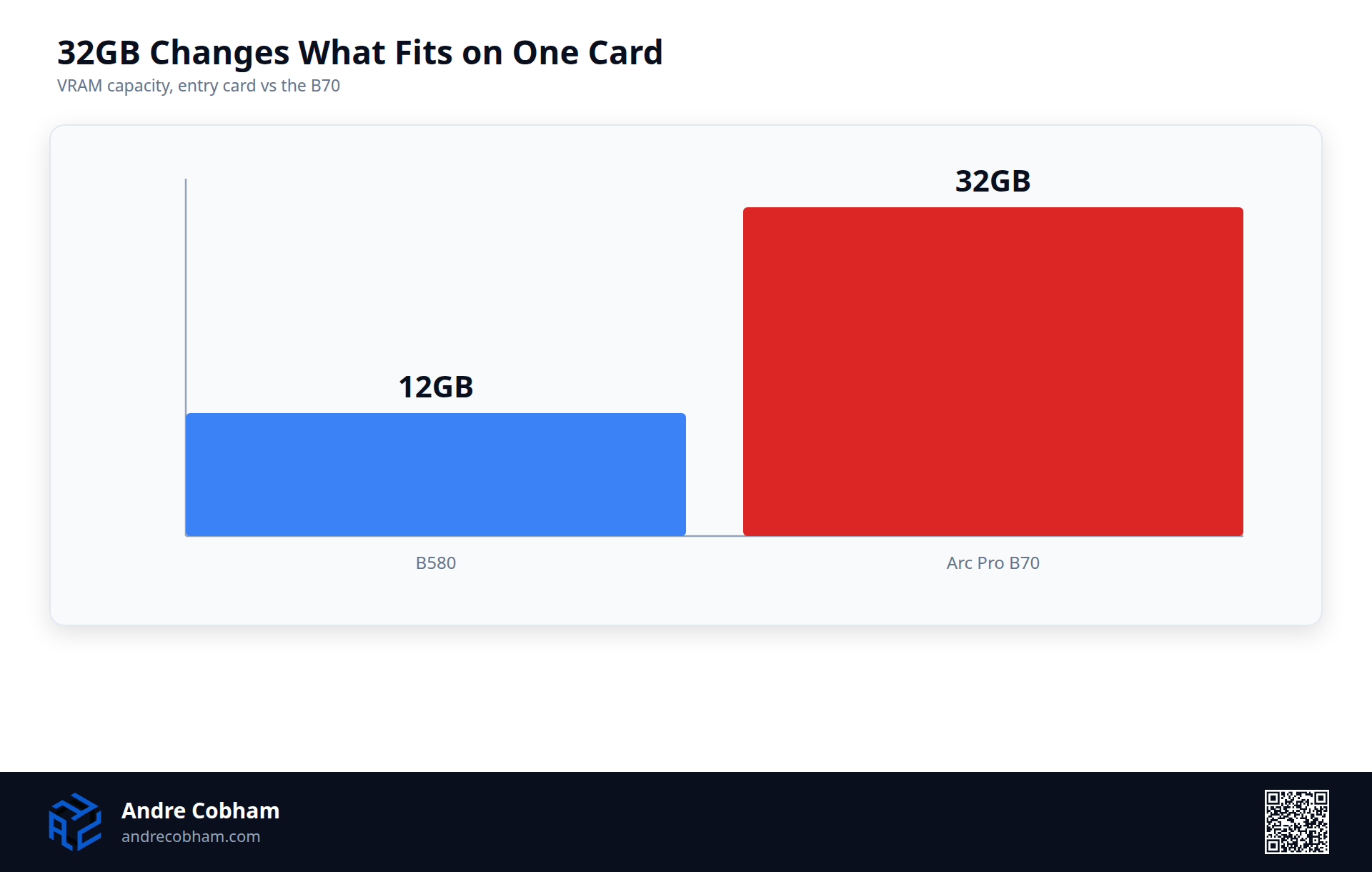
Intel's GPU story in 2026 split into two completely different narratives, and most of the coverage focused on the wrong one. The consumer cards, the Arc B580 and B570 that launched in December 2024 and January 2025, got the headlines. The card that actually matters for anyone building or thinking about local AI infrastructure launched quietly in March 2026 with almost no mainstream coverage. The Arc Pro B70 is a $949 workstation GPU with 32 gigabytes of GDDR6 VRAM. No other card in that price range comes close to that number. That single spec changes the math on private AI inference in a way that deserves a direct look.
I will give you the full picture here, the specs, the benchmark numbers, what it means for running models locally, and the one gap that is real and cannot be glossed over.
TLDR: Intel's Arc Pro B70 launched March 25, 2026 at $949 with 32GB GDDR6, 367 TOPS, and 608 GB/s bandwidth. It runs a 35B parameter model at 54 tokens per second and handles 27B models at full Q8 precision on a single card. The nearest NVIDIA option with comparable VRAM, the RTX 4090, runs $1,600 to $2,000 street price. The catch is a real one: Intel archived its primary LLM acceleration library in January 2026, and the software ecosystem is still catching up to the hardware. If you need maximum VRAM per dollar today and can tolerate less mature tooling, this is the card. If you need production reliability on day one, NVIDIA is still the lower-risk call.
What Intel Actually Shipped This Year
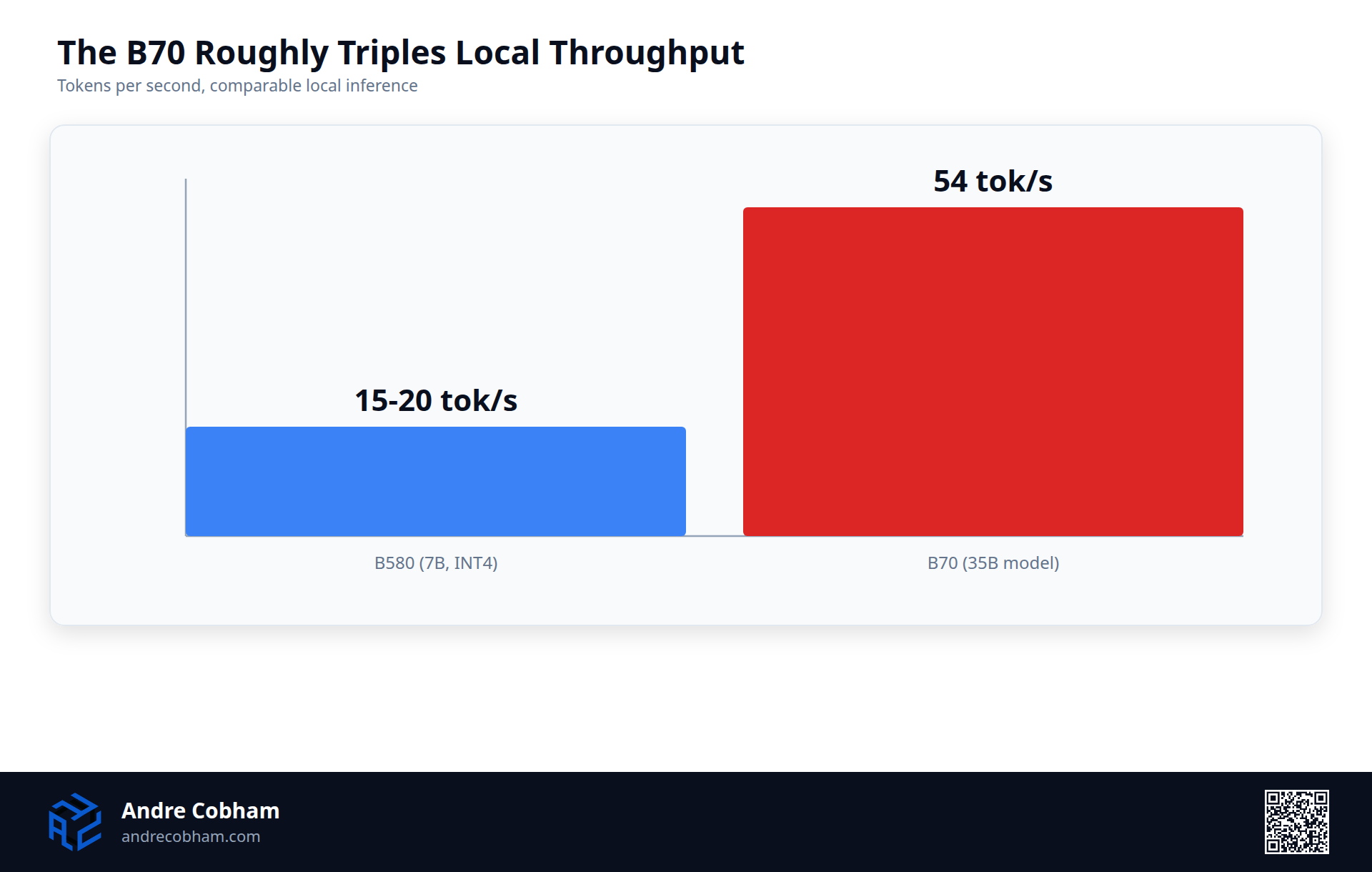
The consumer Arc Battlemage lineup launched first. The B580 at $249 is a legitimate 1440p gaming GPU, it outperforms the RTX 4060 in some workloads and carries 12GB of VRAM versus the 4060's 8GB. For running smaller AI models locally (7B parameter models quantized to INT4), the B580 produces roughly 15 to 20 tokens per second via optimized backends. That is usable for personal experimentation but not for production inference serving multiple users or larger context windows.
The more significant news, the one that did not get nearly enough coverage, was the Arc Pro B70. According to WCCFTech, Intel redirected the full BMG-G31 silicon that was originally planned for a high-end consumer card (which never shipped) into a workstation product instead. The result is a GPU that was designed for gaming at the die level but carries professional workstation memory and positioning. That silicon decision, driven partly by VRAM supply constraints pushing Intel toward higher-margin professional products, produced something genuinely interesting for the AI infrastructure space.
Why 32GB VRAM Changes the Local AI Calculation
The reason VRAM capacity matters for local AI inference is straightforward: a model has to fit in GPU memory to run at GPU speed. If it does not fit, it either falls back to CPU RAM (significantly slower) or you have to quantize it more aggressively to shrink it, which reduces output quality. The VRAM ceiling has been the primary hardware constraint on what models you can run privately, at speed, without cloud dependency.
The Arc Pro B70's 32GB removes that ceiling for a large class of practical models. A 27B parameter model at Q8 precision fits on a single B70 card. A 35B model at Q4 fits. With two B70 cards (64GB combined), you can run a 70B model quantized. A four-card configuration gives you 128GB and brings 120B parameter models within reach. Phoronix Linux benchmarks show a single B70 running Qwen 3.6 35B at 54.7 tokens per second and Qwen 27B at Q8 at 15.3 tokens per second. For context, 15 tokens per second on a 27B model at full precision is a meaningful result, you are not compromising on model quality to hit that number.
The comparison that matters most is against NVIDIA hardware near the same price. The RTX Pro 4000 Blackwell, NVIDIA's closest workstation competitor, carries 24GB of VRAM and sells for $1,481 to $1,800. According to NotebookCheck's performance analysis, the B70 has 33% more VRAM for roughly half the price, and on a long-document RAG pipeline where context window size is the constraint, the B70 handles 93,000 tokens with Llama 3.1 8B before running out of memory, versus 42,000 tokens on the RTX Pro 4000. That is a 2.2x context window advantage for exactly the workloads that matter most for business AI: document analysis, retrieval, and summarization at scale.
Quantization Levels and What You Actually Lose
VRAM determines what quantization level you can use, and quantization level determines output quality. This is worth being precise about because the marketing around quantization often glosses over the practical tradeoffs.
At Q8 (8-bit), a model is operating very close to its full-precision behavior. Most benchmark evaluations show less than 1% degradation versus FP16 on standard tasks. At Q4 (4-bit), you are using roughly half the memory of Q8 but typically see 3 to 8 percent degradation on knowledge-intensive tasks, more on tasks that require precise factual recall. At Q2 (2-bit), you can fit very large models in limited VRAM but the output character changes noticeably on complex reasoning tasks.
With 32GB, the B70 lets you run Qwen3-32B at Q4 (approximately 20GB) with headroom left for the KV cache at reasonable context lengths. Running LLaMA 3 70B at Q2 is technically possible at around 35GB with tight KV cache settings, but you are in aggressive quantization territory where you will notice the quality difference on complex tasks. The sweet spot for this card is 27B to 35B models at Q4 or Q5, which is where you get the best balance of capability, context window, and throughput without spilling into degraded territory.
The Software Gap Is Real and Cannot Be Ignored
Here is the part that I would not be giving you a straight read if I left out. On January 28, 2026, Intel archived the IPEX-LLM repository, its primary library for LLM acceleration on Arc hardware, due to security issues. The Intel Extension for PyTorch followed on March 30, 2026, also archived. These were the mature, supported paths for running AI inference on Intel GPUs. They are now read-only. As XDA Developers noted, this is the core reason NVIDIA keeps winning even when Intel's hardware specs are competitive, the software story falls apart at the exact moment you need it most.
The community is working through alternatives. The SYCL backend for llama.cpp is the current viable path. It requires the Intel oneAPI Base Toolkit (a multi-gigabyte installation), correct environment variable configuration for SYCL device selection, and building llama.cpp from source with the SYCL flag enabled. The build is not complicated for someone comfortable with C++ toolchains, but it is not the three-command Ollama setup you get on NVIDIA. Ollama's Intel Arc support exists but is less mature, and several model quantization formats that work cleanly on CUDA backends require workarounds or patched versions on the SYCL path.
The throughput numbers I cited above, 54 tokens per second on Qwen 35B, are real but they represent the ceiling achievable with careful tuning. The SYCL backend is hitting roughly one-third of theoretical memory bandwidth in some configurations, which means there is performance left on the table that better software could recover. vLLM, the high-throughput inference server that most production deployments on NVIDIA use, does not have stable Arc support. If your production workflow depends on batched inference or continuous batching for multiple concurrent users, you are working without that tool.
The Cost Argument Against Three Years of Cloud Inference
Hardware purchases have to compete against cloud inference costs, and the math on that comparison has shifted significantly over the past eighteen months. If you are running a sustained workload, the amortization case for on-premise hardware is stronger than it was in 2024.
Take a workload where you are processing 2 million tokens per day through a 27B class model for document analysis, legal review, or internal knowledge retrieval. At cloud inference rates for comparable model quality (roughly $0.50 to $1.00 per million tokens input depending on the provider and model tier), that is $1,000 to $2,000 per day, or $365,000 to $730,000 per year. Those numbers are for input tokens. Output tokens are typically priced two to five times higher.
A single Arc Pro B70 at $949, running Qwen 27B at Q8 at 15 tokens per second, handles roughly 1.3 million output tokens per day at continuous utilization. Add a workstation host (call it $1,500 for the platform) and you are at $2,449 in hardware for a system that amortizes against cloud inference spend in under a week at that volume. The ongoing cost is electricity, which at 200W TDP for the card under load runs roughly $0.14 per hour at average US commercial rates, or about $50 per month at 24/7 operation.
The caveat is that this math only works if your workload is sustained and predictable. Cloud inference is the right call for bursty workloads, for workloads where the model you need keeps changing, and for anything where you cannot absorb downtime if the hardware fails. The economic argument for on-premise is strongest when you know what model you need, you are running it continuously, and the data cannot leave your environment anyway.
Which Models Fit and at What Precision
What Does Not Work Yet on Intel Arc
Beyond the archived libraries, there are specific capability gaps that matter for production AI workloads. Flash Attention, the memory-efficient attention mechanism that significantly improves throughput at long context lengths on CUDA, is not fully supported on the SYCL backend. This means that at long context lengths, the B70 is not getting the same efficiency gains that NVIDIA cards get, and the throughput advantage narrows as context length increases.
Speculative decoding, a technique that uses a small draft model to propose token sequences for the main model to verify, cutting effective latency significantly, is also not available via the SYCL path in llama.cpp. On an RTX 4090 running llama.cpp with CUDA, speculative decoding can push throughput 2x to 3x higher than the base inference rate. That advantage does not exist on the B70 right now.
Driver stability on Linux is better than it was a year ago, but the Arc driver stack has historically had more edge-case failures than NVIDIA's under heavy AI workloads. The ECC VRAM helps with data integrity in workstation use, but driver crashes under sustained inference load have been reported in the r/LocalLLaMA community on Arc hardware. This is not universal, but it is not rare enough to ignore when you are planning a production deployment.
When I Would Recommend the B70, and When I Would Not
The Arc Pro B70 is the right call in a specific scenario: you need to run 27B to 70B parameter models privately, on your own hardware, without cloud data exposure, and you want to do it at the lowest hardware cost possible. The $949 price point with 32GB of VRAM has no NVIDIA equivalent. If your use case requires large context windows, extended documents, legal review, multi-document analysis, the B70's memory capacity advantage over NVIDIA's similarly-priced cards is not close.
The profile of someone who should buy this card looks like: a developer or small team comfortable working from source builds, a workload that is primarily single-user or low concurrency (not serving 20 simultaneous users), data sensitivity that rules out cloud APIs, and patience for a setup process that takes a day rather than an afternoon. That is a real segment. It is not a general-purpose recommendation.
I would not recommend it for a production system that needs to be running reliably on day one with minimal setup. The toolchain is still stabilizing after Intel's library archival in January. If you need something that follows a documented path from installation to inference in a predictable afternoon, NVIDIA is still the lower-friction option. The RTX 4090 at $1,600 gives you a mature CUDA ecosystem, vLLM support, Flash Attention, speculative decoding, and a community that has debugged virtually every inference configuration you might attempt. You are paying a 68% premium over the B70 for software maturity, and for many production deployments that premium is worth it.
The longer-term picture for Intel GPU AI infrastructure is less clear. The consumer flagship B770 was cancelled. Falcon Shores, the next-generation hybrid accelerator, was pulled as a product and repurposed as an internal test chip. According to Tom's Hardware, Intel acknowledged publicly that it missed the AI wave with Gaudi 3 and that Jaguar Shores requires fast iteration to be competitive. The Arc Pro B70 is a genuinely interesting product in isolation. The broader Intel AI infrastructure roadmap is still being rebuilt.
My Take on Holding Tight as the Market Moves
Here is where I land on this for clients who ask me directly. Unless you have a specific constraint right now, you are processing large documents at scale, you cannot use cloud APIs for privacy reasons, and you need to move this quarter, I would hold tight and let the GPU market settle before committing hardware budget.
The Arc Pro B70 is the most interesting VRAM-per-dollar story in years. A 32GB workstation card at $949 is a genuine market gap that Intel found and filled, even if they found it by accident while redirecting silicon that was meant for consumers. The benchmark numbers are real and the cost arithmetic against cloud inference holds up at sustained workloads.
But the software situation is genuinely unsettled in a way that matters. Buying into a platform that just archived its primary AI library requires more tolerance for operational friction than most business deployments have room for. The hardware value is real. The timing question is still open, and for anything beyond a personal or research workload, that question should be part of the decision.
Stay Current
Get notified when I publish.
No newsletter cadence. No filler. I write when there is something worth saying about AI systems, infrastructure, and what is actually working in practice.
Building Private AI Infrastructure? Let's Talk.
I help businesses deploy AI that runs on their own hardware, no data leaving their environment. If you are evaluating on-premise AI, the strategy call is a good place to start.