Running both models through the same invoice processing workflow, the same lead classification system, and the same content generation pipeline over six weeks of real client work. Most of what I read about these models before I started testing turned out to be wrong in the ways that matter most.
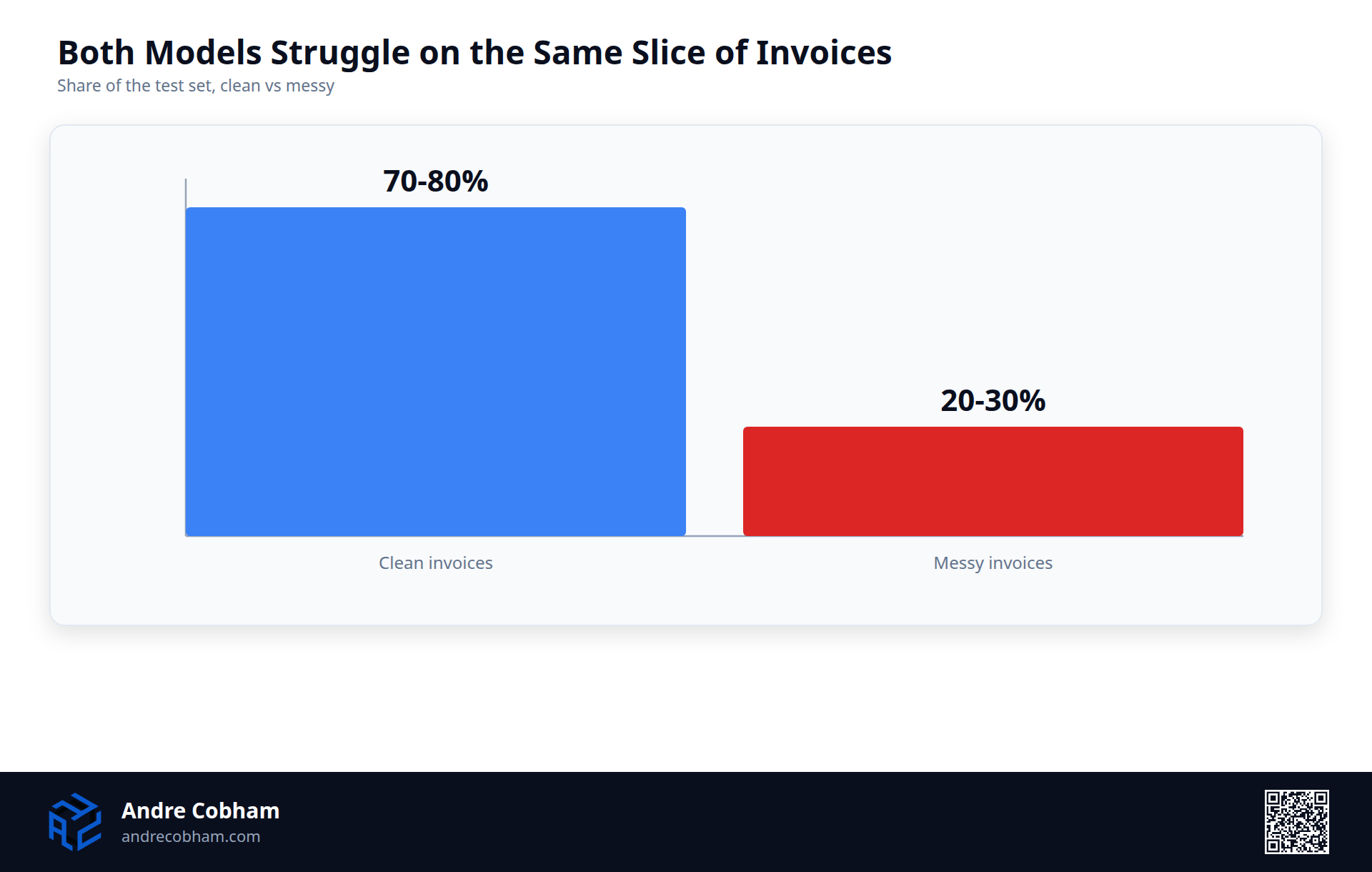
In my opinion, twenty to thirty percent is the edge case volume in real invoice processing workflows. Benchmarks do not tell you what happens in that 20-30%. That is where the decision between Qwen3 and Gemma 3 actually gets made.
What Qwen3 and Gemma 3 Are
Qwen3 is Alibaba's third-generation open-weight model family, released in April 2025. The lineup runs from 0.6B parameters up to 235B with a mixture-of-experts architecture at the top end. The sizes tested were Qwen3-8B and Qwen3-14B, which are the practical range for local deployment without enterprise GPU hardware. Qwen3 introduced a "thinking mode" toggle that enables extended chain-of-thought reasoning at the cost of additional tokens and latency. The qwenlm.github.io release post covers the architecture in detail, including the MoE variants.
Gemma 3 is Google's open-weight family released in March 2025, built on the same research base as Gemini but designed for local and edge deployment. Sizes are 1B, 4B, 12B, and 27B. Gemma-12B ran as the primary comparison point against Qwen3-8B because they have similar VRAM requirements and fit on the same hardware. Google's technical report at ai.google.dev covers the training methodology and benchmark results.
Both models run locally via Ollama with good quantization support. Both are instruction-tuned and usable out of the box without fine-tuning for most business tasks. Those surface similarities are where the easy comparison ends.
Test 1, Invoice Processing and JSON Extraction
The workflow: PDF invoices processed through OCR, producing messy text with inconsistent formatting. The model's job is to extract a structured JSON object with fields for vendor name, invoice number, date, line items with quantities and unit prices, subtotal, tax, and total. The challenging cases are invoices with non-standard layouts, combined fields, amounts expressed in words rather than digits, and line items that span multiple OCR lines.
On the clean 70-80% of invoices, both models performed well. Extraction accuracy was high and the JSON output was valid. Qwen3-8B was marginally faster on this set, completing extraction in about 1.8 seconds per invoice on average versus Gemma-12B at 2.4 seconds on my iGPU setup.
In the edge cases, the gap opened up. Qwen3-8B followed the system prompt instruction schema more consistently. When the invoice had an unusual structure, Qwen still produced a valid JSON object with null values for fields it could not find, which is the correct behavior when you need to catch and review exceptions downstream. Gemma-12B, under the same prompt, would sometimes restructure the JSON output to match what it inferred the invoice contained rather than what the schema specified. That sounds reasonable but it breaks downstream parsing because the field names changed.
Instruction adherence under schema constraints is where Qwen3 wins this test. Gemma-12B is applying more inference about the "right" answer and less literal interpretation of the schema. In tasks where the schema is the truth, that creative interpretation is a bug.
Test 2, Lead Classification and Calibration
The lead classification task: given a form submission from a potential client including their business description, budget range, timeline, and project description, score the lead on a 1-10 fit scale and produce a structured output with the score, a one-sentence rationale, and a recommended next action from a fixed list.
A labeled set of 340 historical leads with human-assigned scores served as the calibration benchmark. Neither model was shown these labels during the task. Both ran against all 340 and scores compared to the human benchmark.
In my opinion, gemma-12B had better calibration on this task. Its scores tracked the human benchmark more closely, with a mean absolute error of about 1.4 points on a 10-point scale versus Qwen3-8B at about 1.9 points. The pattern in Qwen's errors was a tendency to score higher than humans on leads that described ambitious-sounding projects. It seems to weight stated aspiration more than humans do when assessing fit. Gemma was more conservative and ended up closer to the human judgment on average.
The rationale quality was closer between the two models. Qwen's rationales were slightly more specific. Gemma's were slightly better formatted and more consistent in length. For a system where a human reviews the rationale before acting, both were acceptable. For a fully automated pipeline where the rationale is surfaced directly, Gemma's consistency would be preferable.
Test 3, Short-Form Business Content
The content task: generate a 150-200 word service description for a specific professional service offering, given a brief with the service name, target audience, three key benefits, and a differentiator. Evaluate on accuracy to brief, clarity, and absence of generic filler language.
Neither model produced content I would publish without editing. That is not a criticism specific to these models; it is true of frontier models as well for branded content. The question here was which model's output required less editing and was closer to usable on the first pass.
Gemma-12B produced tighter, more structurally clean copy on this task. Less padding, more direct language. Qwen3-8B had a tendency to include transitional phrases and qualifiers that added word count without adding meaning. Running the same brief through Qwen3-8B with thinking mode enabled, the output quality improved noticeably. The extended reasoning pass seemed to catch and remove some of the filler before producing the final output. The cost is that thinking mode adds 3-8 seconds to the response time on local hardware.
Task Performance Comparison (Andre's Tests, 1-10 Scale)
Scores reflect Andre's direct evaluation across 6 weeks of client workflow testing. Qwen3-8B leads on instruction-following precision. Gemma-12B leads on calibration and content quality.
Local Deployment on iGPU and Throughput
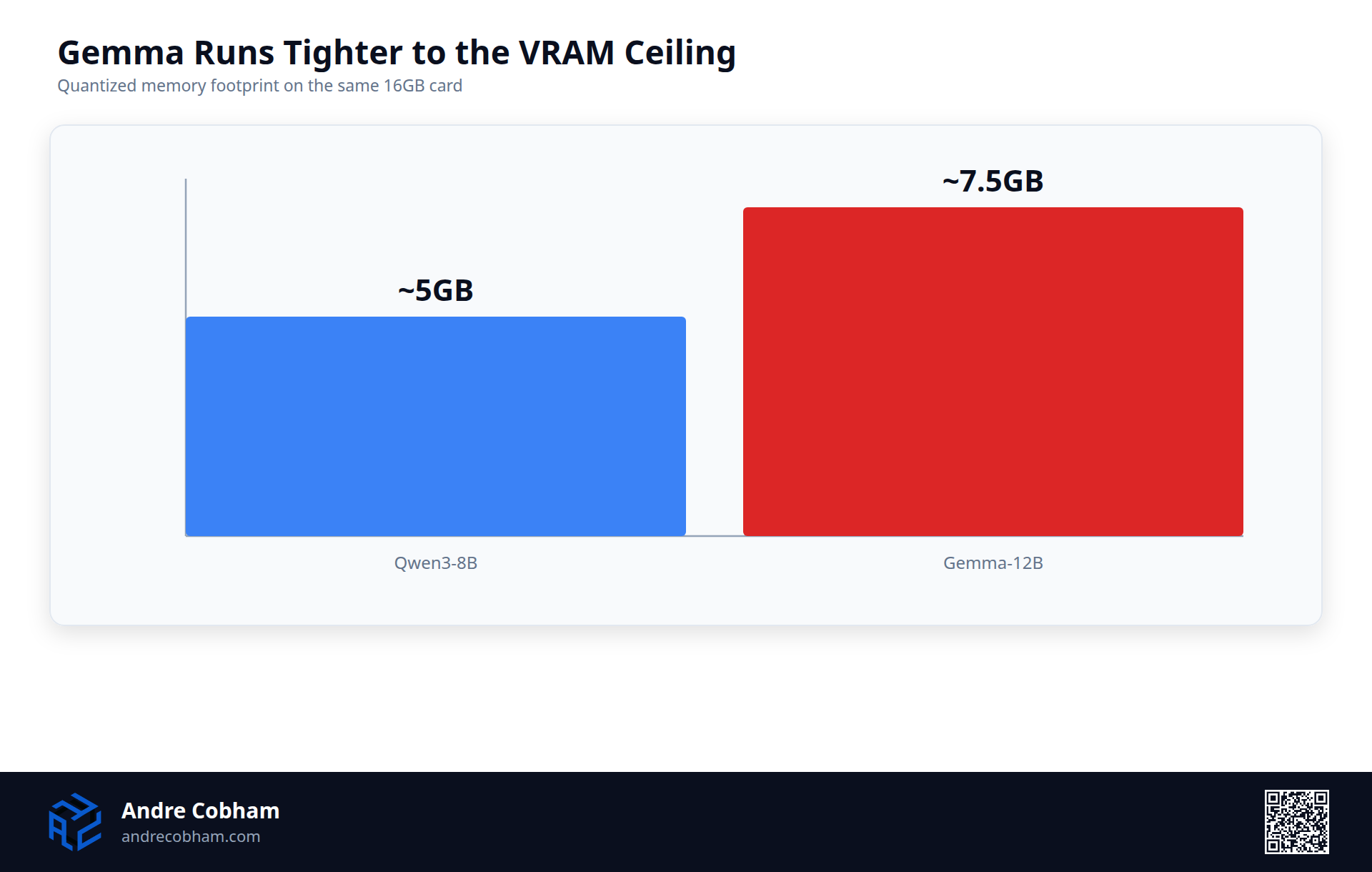
Both models ran on my local setup with an Intel Arc GPU sharing 16GB of system memory. Qwen3-8B-Q4_K_M quantized at roughly 5GB VRAM usage through Ollama, leaving headroom for other processes. Gemma-12B at Q4_K_M quantization used approximately 7.5GB, which was workable but tight.
Community benchmarks on Intel Arc for llama.cpp, documented in GitHub issues on the llama.cpp repository and threads on r/LocalLLaMA, show Qwen3-8B running at approximately 18-25 tokens per second on Arc B580 class hardware. Gemma-12B on the same hardware runs at approximately 12-16 tokens per second due to the larger model size. My measured numbers were roughly consistent with the community figures, sitting at the lower end of those ranges, likely due to memory bandwidth sharing with system RAM.
For batch processing tasks where throughput matters more than latency, Qwen3-8B's speed advantage is meaningful. At 20 tokens per second versus 14, you process roughly 43% more output in the same wall-clock time. For interactive tasks where you are waiting on a single response, both feel usably fast.
What Thinking Mode in Qwen3 Actually Adds
Qwen3's thinking mode enables an extended internal reasoning chain before producing the final output. You toggle it with a system prompt flag or model parameter depending on the inference backend. The effect is most visible on tasks that require multi-step reasoning or constraint satisfaction, like parsing a complex invoice with ambiguous fields or classifying a lead where several signals point in different directions.
From my perspective, for the invoice task, thinking mode reduced schema violations by approximately a third in my edge case set. For the lead classification task, it reduced the score deviation from the human benchmark from 1.9 to about 1.5 points mean absolute error. For content generation, as I noted, it reduced filler language. The cost is added latency, between 3 and 10 seconds extra depending on the task complexity.
The practical application is to default to standard mode for high-volume, time-sensitive tasks and enable thinking mode only for the complex exceptions or for tasks where quality improvement justifies the latency hit. It is not a binary architecture decision; you can apply it selectively within the same pipeline.
Which Model for Which Use Case
Use Qwen3-8B for structured extraction, JSON schema adherence, data transformation, and any task where the output format is more important than the inferred content. Its instruction adherence under constraint is the strongest feature in my testing. Enable thinking mode for complex edge cases within those same task types.
Use Gemma-12B for classification tasks that require calibrated scoring, content drafts that need to be structurally clean, and workflows where you are generating human-reviewed output and want something closer to done on the first pass. Its calibration against human judgment in scoring tasks was the clearest performance gap in the data.
Neither model replaces frontier models for reasoning-heavy tasks. Long-context analysis, complex multi-step planning, and tasks that require synthesis across large information sets still belong on Claude or GPT-4o in my current setup. The value of Qwen3 and Gemma-12B is in the high-volume, defined-scope business task layer where local deployment economics make the cost difference matter and the task complexity is within their capability range.
Six weeks of real workloads produced a clear answer for my setup: Qwen3-8B for extraction pipelines, Gemma-12B for classification and content. Both in Ollama, both on the iGPU, both serving different parts of the same client workflows simultaneously. The benchmark leaderboards did not predict that split. The actual work did.
Running Both Models Together and What That Looks Like in Practice
In a typical client workflow both models run loaded and available simultaneously through Ollama. The routing logic is simple: if the task requires producing a structured output against a defined schema, the request goes to Qwen3-8B. If the task requires scoring, ranking, or drafting that will be reviewed by a human, it goes to Gemma-12B. That routing decision is made at the prompt dispatch layer with a two-field task type tag, not by inspecting the content of each request.
Memory usage with both models loaded concurrently on the 16GB iGPU setup is tight but workable. Qwen3-8B-Q4_K_M at roughly 5GB and Gemma-12B-Q4_K_M at roughly 7.5GB leaves approximately 3.5GB for system processes. No OOM condition appeared in six weeks of daily use, with no other GPU-intensive process running alongside. If you are on a system with less shared memory headroom, loading on demand and evicting between tasks is the safer approach, at the cost of a 10-15 second reload delay per model switch.
The MMLU benchmark data on qwenlm.github.io shows Qwen3-8B scoring competitively with models twice its size on knowledge and reasoning tasks. Gemma 3's technical report on ai.google.dev shows similar benchmark positioning for Gemma-12B. What neither benchmark captures is the task-specific behavior I described above. MMLU measures general knowledge recall under multiple-choice conditions. It does not measure JSON schema adherence under adversarial invoice formatting, which is the task that actually determined model selection for extraction. Benchmark-to-production transfer is imperfect for every model, which is why six weeks of real workflow testing is more informative than any leaderboard position.
The question I get asked most often when I describe this setup is whether the quality gap between local 8-12B models and frontier models is material enough to matter for business tasks. For the three task types tested, extraction, lead classification, and short-form content, the answer is that the gap is smaller than most people expect and larger than benchmarks suggest in specific failure modes. For tasks that stay within the capability range of a well-prompted 8-12B model and that have a defined correct answer structure, local models close most of the gap with frontier models. For tasks at the edges of that range, the failure modes are sharper and less predictable than what you see from Sonnet or GPT-4o. Knowing where those edges are for your specific workflow is the work that benchmarks cannot do for you.