
I audit Google Business Profiles for a living, and the failure is almost never a missing field. The business stuck at position five filled everything out on setup day, picked a category, wrote a description, uploaded a few photos, and never opened the dashboard again. It treats the profile as paperwork. Google treats it as a live signal that reports whether the business is still active this week. That gap between filed once and operated weekly is the entire reason one plumber owns the map while the identical plumber two miles away is invisible. The profile did not fail. The owner stopped running it.
Google ranks the local pack on relevance, distance, and prominence, and its own help page confirms those three. Distance is fixed, so your real work sits in the other two. Your primary category is the strongest relevance signal you control, and the wrong one is the single biggest thing holding you down. Prominence moves on review velocity and fresh photos, both measured continuously, not on a one time setup. Run the profile like an operator every week and you climb, file it once and you stall.
The Pack Is Three Slots and Everything Below Is a Click Nobody Makes
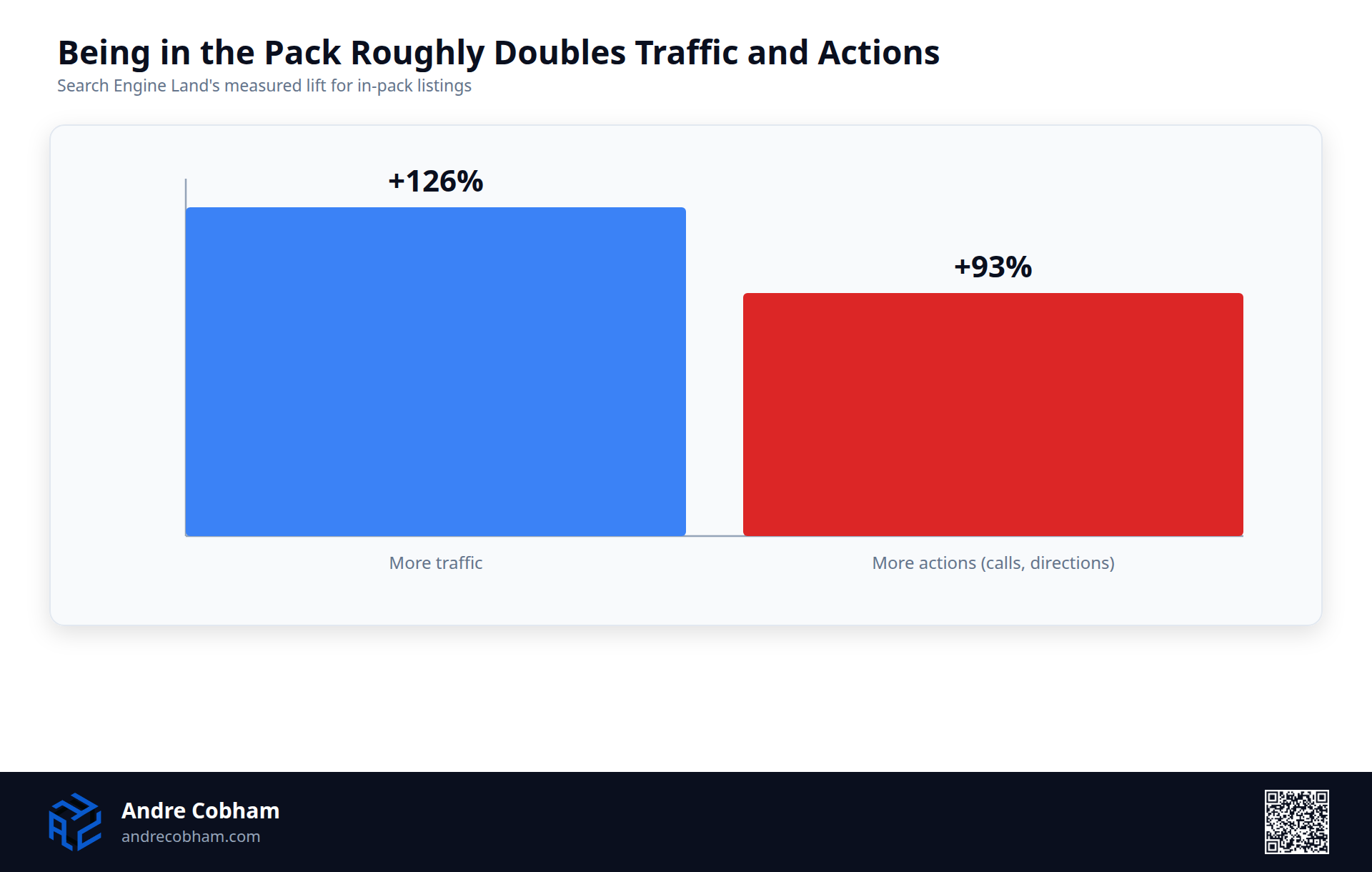
When someone types a service and a city into Google, the three business map block loads above the organic links, and that block collects the demand. Search Engine Land's guide to the local pack puts the difference at 126 percent more traffic and 93 percent more actions, calls, direction requests, and website clicks, for listings inside the pack versus the ones ranked below it. That is not a rounding error. That is most of the market walking through three doors.
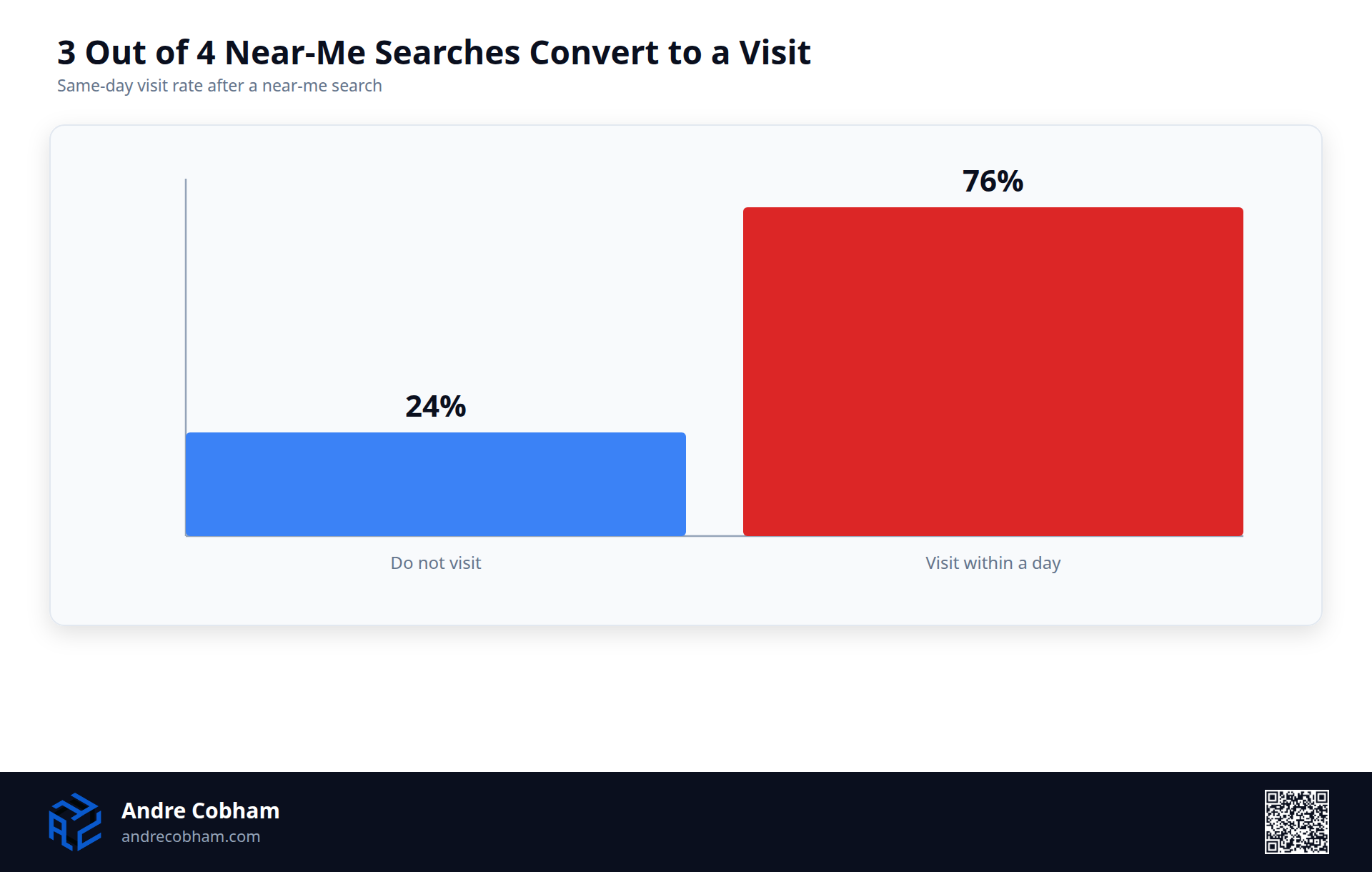
Here is the part owners misread. They assume ranking anywhere on the first page is a win. The pack shows three businesses and stops. Seeing a fourth means tapping "more places" to open the local finder, and the overwhelming majority of searchers never make that tap. The urgency behind those searches is real, Think with Google reports that 76 percent of people who run a near-me search on a smartphone visit a related business within a day. So the fight is not to appear on the page. It is to hold one of three slots, because slot four is a click almost nobody performs, and the searcher is buying today.
That reframes the whole problem. You are not competing to be listed somewhere. You are competing for one of three chairs at a table that seats three.
Your Primary Category Decides Whether You Are Even in the Conversation
Relevance is where most owners quietly lose before they start. Google's own guidance on local ranking names three factors, relevance, distance, and prominence, and relevance is how closely your profile matches what the searcher typed. The strongest relevance signal you control is your primary category, and Whitespark's ranking factor tier list places primary category in the top tier, the must have level, while naming the wrong primary category as the single biggest negative factor a profile can carry. Set it wrong and nothing else you do rescues the listing.
Specificity is the rule Google states plainly. Its help page on categories tells you to pick the most precise option available, choose Nail salon over Salon, Emergency plumber over Contractor, because the categories you select directly affect your local ranking. Owners pick the broad category out of a fear of missing searches. The broad category is exactly what buries them, because a hundred vaguely related businesses share it and none of them reads as a tight match.
Secondary categories are for services you genuinely deliver, nothing more. Add the three or four that are true and stop. A profile padded with categories you listed to surface in more searches reads as less relevant, not more, because the primary signal gets diluted by trades you barely touch. Your description contributes too, so lead the first sentence with your core service and your city, but treat it as a supporting player. A flawless description sitting on the wrong primary category is a fast car stuck in the wrong gear.
Distance Is the One Factor You Cannot Move
Distance is the factor you cannot argue with. Google measures it from the searcher to your verified address, and no amount of optimization shortens the road. The expensive mistake owners make here is renting a second address or a virtual office to fake proximity, which violates Google's guidelines and gets listings suspended, not ranked.
The useful truth about distance is that a strong profile earns a wider radius. Google shows a well categorized, actively reviewed, freshly photographed listing to searchers who sit farther out than it ever shows a neglected one at the same corner. The businesses that own a whole town are not physically closer to every customer. They are prominent enough that Google trusts them across a bigger circle. Distance sets the floor. Relevance and prominence raise the ceiling, and the ceiling is where you win the ranking.
Prominence Runs on Review Velocity, Not Your Lifetime Total
Prominence is where the movement lives, and it is the factor owners treat as finished the day they open the doors. It is never finished. Whitespark's data is blunt on the mechanics, the number that moves rank is not your lifetime review total, it is velocity, the rate of fresh reviews arriving now. A shop earning two or three genuine reviews a week climbs past a competitor sitting on four hundred lifetime reviews that stopped arriving three months ago. Recency, rating, and count work together, and recency is the part most owners ignore.
This is where I have to kill a comfortable myth. Owners believe that replying to every review lifts their ranking, so they pour energy into responses and neglect the ask. Whitespark is clear that responding to reviews does not move rank at all. It is a trust and conversion play, it shows a prospect reading your profile that a real person is present, and it occasionally changes a reviewer's mind. Worth doing. It is not a ranking lever. The new review is the lever. The reply is the handshake after.
The Weekly Ask That Keeps Review Velocity Steady
The reason most businesses have dead review velocity is not that customers refuse. It is that no one asks, or someone asks once a quarter in a burst. Velocity needs a cadence, and the cadence has to attach to a moment that already exists in the workday. Ask the same day the work finishes, while the customer is still standing in the result of it and the goodwill is at its peak. A week later the feeling has faded and the reply rate falls off a cliff.
Here is the operating version I set up for clients. Every completed job triggers a single request, sent by text with a direct link to the review form, because a link removes the five steps between wanting to help and finding the page. One ask, one link, same day. If you close ten jobs a week and one in three leaves a review, that is three fresh reviews a week and roughly a hundred and fifty a year of steady velocity, which reads to Google as a business that is unmistakably active. Do not buy reviews and do not gate them by asking only the happy customers, because Google detects both and the penalty erases the gain.
The mechanics matter less than the consistency. A rough system that runs every week beats a perfect system that runs when someone remembers. Pick the trigger, write the one message, send the link, and let the same day timing do the work.
Google Reads Your Photos, So Feed It Real Ones Every Week
Google reads your photos now, and that changed the job. Whitespark rates photos a high impact factor precisely because Google uses AI to interpret the contents of every image you upload, the room, the equipment, the finished work, the storefront. A photo is no longer decoration on the listing. It is information Google extracts and matches against searches, relevance the text fields cannot carry on their own.
That means the photo strategy is about feeding the machine real, current, specific images on a schedule. Upload two or three recent job photos every week with accurate location detail, shot on a real phone in real conditions, not stock images and not the same five staged shots from setup day. Show the actual work, a repaired panel, a finished install, the crew on site, because those are the images Google can read and connect to what people search. A steady stream also signals an active business, the same way review velocity does, while a profile frozen on its launch day photos signals a business that stopped.
Owners who add photos on a regular cadence see movement. Owners who uploaded ten on day one and never returned watch a competitor with fresher, more specific images pass them for the same search. The camera is already in your pocket. The only variable is whether you use it every week.
Run a Grid Audit to See Exactly Who Beats You
Before you change anything, find out exactly who beats you and on which signal, because the fix depends entirely on the gap. The tool for this is a grid audit, a scan that checks your ranking for a keyword across a grid of geographic points around your location instead of the single spot where you happen to be sitting. Your own phone always shows you near the top because you are standing on your address. The grid shows the truth, that you rank third downtown, seventh on the north side, and nowhere out east.
Run the grid for your primary keyword, then pull up the two or three competitors who consistently outrank you and read their profiles against yours on the signals that move rank. Compare primary category first, because a category mismatch explains more losses than everything else combined. Then compare review count and, more important, review recency, are their newest reviews from this week or last spring. Then compare photo freshness and volume. You are building a scorecard, you versus the winner, on category, velocity, and photos, and the column where the gap is widest is your first project.
This is the difference between guessing and operating. Most owners optimize the thing that feels productive, usually the website copy, while the actual gap is a stale category or a review stream that dried up in March. The grid audit turns a vague ranking complaint into a named signal you can fix this month.
The Three Mistakes That Quietly Tank a Profile
A few specific mistakes tank profiles faster than anything on the optimization side builds them, and I see the same three on nearly every audit. The first is stuffing keywords into the business name. Owners rename the listing from Cobham Plumbing to Cobham Plumbing Emergency Drain Repair Water Heater Service because it feels like free relevance. It violates Google's guidelines, which require the real world business name, and it exposes the listing to suspension by any competitor who reports it. The short term bump is real. So is the account termination that follows.
The second is category churn. An owner reads that category matters, panics, and starts swapping the primary category every few weeks chasing a different search. Every change resets Google's confidence in what the business is and stalls the ranking while the profile rebuilds trust. Choose the correct primary category once, deliberately, and leave it unless your actual service mix changes. Stability is a signal. Thrash is the opposite.
The third is the fake service area. Service area businesses hide their address and list the regions they cover, and owners abuse this by claiming twenty towns they have never worked in, hoping to rank in all of them. Google does not reward the padded radius, it dilutes the profile and can flag it, and a listing claiming half a state reads as less trustworthy than one claiming the five towns it actually serves. Claim the area you truly cover. An honest, tight service area outranks an inflated one every time.
My Take
Here is where I land when an owner asks me straight. Most of them want to hire an agency to fix their Google ranking, and most of what an agency bills for on a local profile is work the business can do itself in twenty minutes a week. The profile does not need an expert. It needs an operator. Correct primary category set once, two or three fresh reviews arriving every week, real job photos going up on a schedule, an honest service area. That is ninety percent of local ranking, and none of it requires a retainer.
Where I actually earn my fee is not filling in the profile, it is building the system that makes the weekly habit happen without the owner having to remember, and reading the grid to name the exact signal a competitor is beating them on. If your profile has not been touched since the day it went live, you do not have a ranking problem. You have an operating problem, and that is the good news, because an operating problem is one you can start fixing this week without spending a dollar.
If you want a straight read on where your profile stands against the businesses ranking above you, and which signal is costing you the slot, reach out and we will look at what is actually happening on the map.