Google just published the architecture details behind Virgo Network, and most of the coverage missed what it actually means. The headlines called it a networking announcement. It is an AI systems announcement. The reason it matters is not the raw bandwidth numbers. It is the latency profile at scale, and what that latency profile makes possible for multi-agent AI architectures that were not viable before.
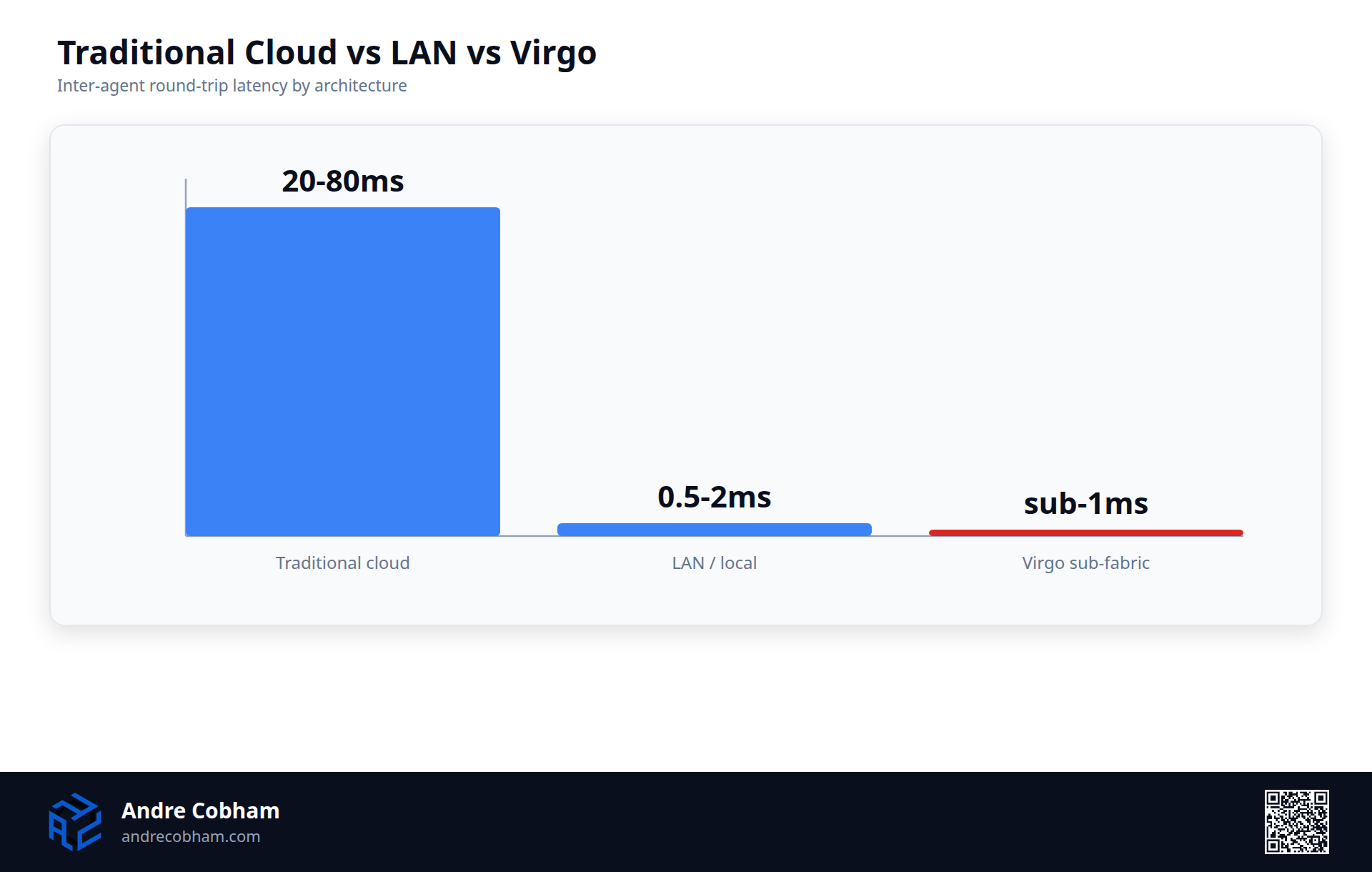
In my opinion, twenty to fifty milliseconds is the round-trip latency for inter-agent hops in traditional cloud deployments. Sub-millisecond is Virgo's target for intra-fabric coordination. That gap changes what is architecturally feasible for agents that need to call each other synchronously.
Where Current Agentic Pipelines Hit the Latency Wall
I have been building multi-agent pipelines for client work since early 2024. The pattern I kept running into was not model quality. It was coordination overhead. When you orchestrate five agents in a LangGraph workflow, each handoff carries a network round-trip. On Vertex AI, those round-trips average between 20 and 80ms depending on region and load. That sounds fast until you chain ten of them together in a single user-facing request.
In practice, a pipeline with seven synchronous agent hops adds 140 to 560 milliseconds of pure coordination latency before any model inference runs. For a batch enrichment job processing thousands of records overnight, that is acceptable. For a real-time customer-facing workflow where a human is waiting, it is not. So the design choice I kept making was to push agents to run asynchronously wherever possible, which means the orchestration logic becomes more complex and the error surface grows.
LangGraph mitigates some of this by letting you define graph edges that execute in parallel where dependencies allow. But the underlying network calls still cost what they cost. LangChain's own documentation acknowledges that production deployments should budget 50-200ms per agent invocation in cloud environments when accounting for cold starts and network variance. The framework cannot compress the physics of packet travel between data centers.
What the A2A Protocol Adds on Top of Virgo
Google introduced the Agent-to-Agent protocol at Google I/O 2025 as an open standard for how AI agents communicate across different systems and vendors. The spec defines a JSON-based message format for agent discovery, capability negotiation, and task handoff. What A2A does on its own is standardize the envelope. What Virgo does is make the delivery of that envelope fast enough that synchronous agent-to-agent calls become practical at scale.
Without Virgo-class latency, A2A is useful for asynchronous workflows where agents post tasks and poll for results. Reasonable, but not architecturally different from a message queue. With sub-millisecond intra-fabric latency, A2A becomes a synchronous call mechanism where agent A can block on agent B's response without the user noticing. That is the shift. It turns agent-to-agent communication from an I/O-bound asynchronous problem into something closer to an in-process function call.
The A2A protocol spec was published openly. Multiple third-party agent frameworks have begun adding A2A transport support, which means the standard has a reasonable chance of outlasting any single Google product. That matters for builders who want to invest in an interoperability layer that does not depend on one vendor's roadmap.
Agent Space and Vertex AI Agent Infrastructure Today
Google Agent Space, announced at Google I/O 2025, is the product that sits on top of Vertex AI's agent infrastructure and is aimed at enterprise knowledge workers. It connects internal enterprise data to Gemini-powered agents and surfaces them through a search-like interface. The underlying plumbing, Vertex AI Agent Engine, handles orchestration, memory, and tool dispatch for those agents.
From a builder's perspective, Vertex AI Agent Engine is the more interesting infrastructure piece. It provides managed state, session tracking, and now A2A-compatible agent endpoints. Combined with Virgo latency targets, it is positioning Vertex as the fabric for enterprise agentic deployments where multiple specialized agents need to collaborate within a single user session.
I have seen this firsthand: i have not moved client production pipelines to Vertex Agent Engine yet. The managed infrastructure costs are higher than self-managed LangGraph deployments, and the observability tooling was still immature as of early 2026. But I track it closely because the operational overhead of managing agent state and session continuity myself is real, and a managed layer that absorbs that complexity would change the build calculus significantly.
Inter-Agent Latency Comparison
Virgo's sub-millisecond intra-fabric target compresses coordination latency by roughly 50-100x vs traditional cross-datacenter cloud networking. Source: Google Virgo Network architecture documentation and Google I/O 2025 sessions.
What Sub-Millisecond Latency Actually Unlocks
The concrete architectural change is that synchronous five-plus agent workflows become viable for interactive applications. Right now, if I build a workflow where a routing agent, a research agent, a drafting agent, a fact-check agent, and a formatting agent all need to run in sequence within a user-visible response, the coordination latency alone pushes response time past acceptable thresholds for interactive use. So I either collapse the agents into a single larger prompt, losing specialization, or I make the workflow asynchronous and show progress states to the user.
With sub-millisecond coordination, a five-agent sequential workflow adds less than five milliseconds of network overhead. Model inference latency still dominates, but the orchestration layer becomes essentially free. That means specialization does not cost you in wall-clock time for the user. You can route to a smaller, faster, cheaper specialist model for each subtask without paying a coordination tax.
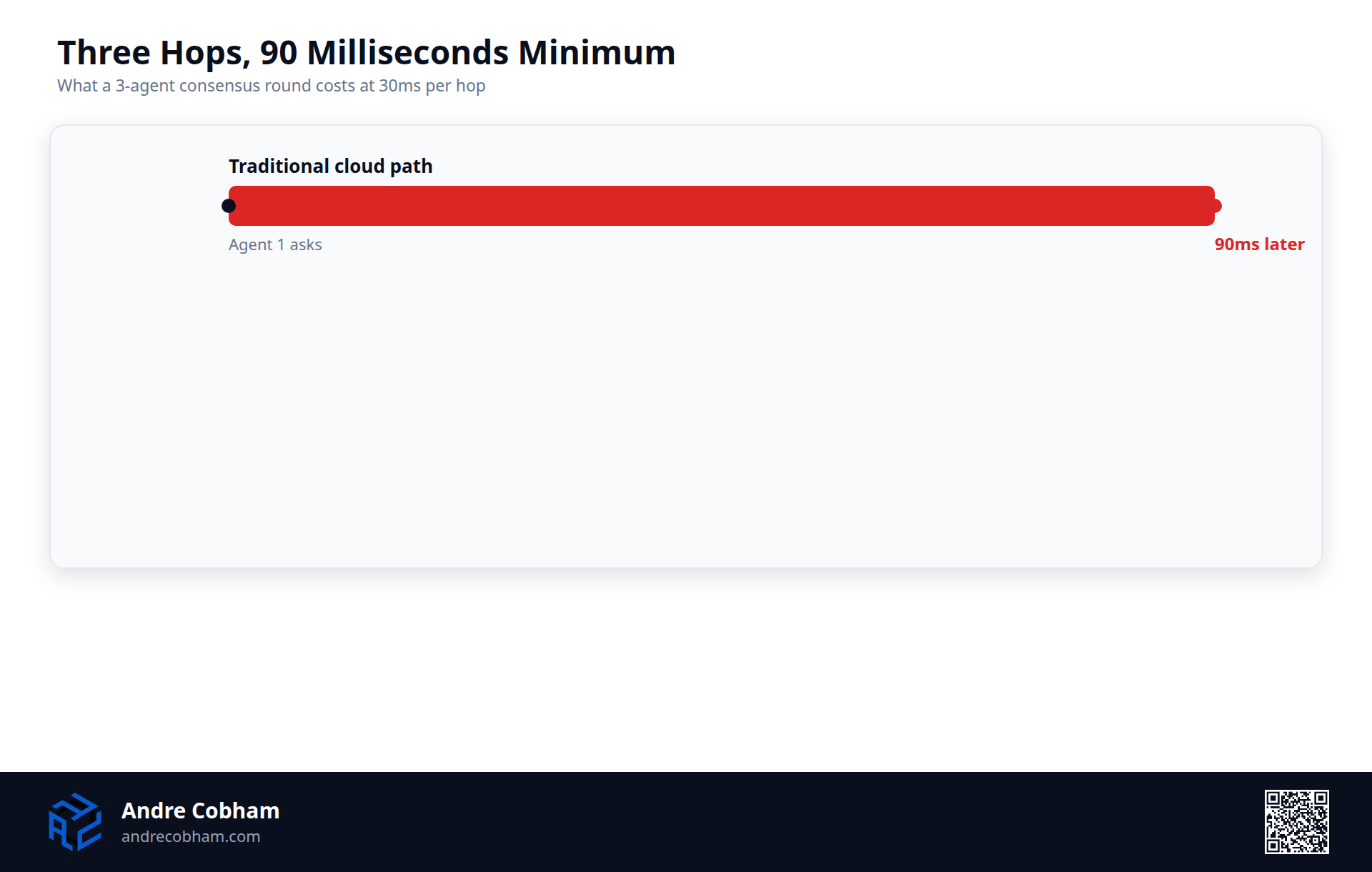
Real-time agent consensus is the other capability this unlocks. Consensus protocols where multiple agents vote on an output before it is delivered require synchronous round-trips between agents. At 30ms per hop, a three-agent consensus round adds 90ms minimum. At sub-millisecond, the same consensus round adds under three milliseconds. That is the difference between a feature you cannot ship to interactive products and a feature that fits inside a normal response latency budget.
What Virgo Does Not Solve
Latency is not the only constraint in multi-agent systems. Semantic routing is still an unsolved problem that Virgo does not touch. When an orchestrator agent needs to decide which specialist agent to call for a given subtask, it needs a routing signal. Today that is either a hard-coded rule, an embedding similarity lookup, or another LLM call. None of those are fast or cheap at scale, and Virgo's network speed does not change them.
State management is the other gap. Multi-turn agent workflows need shared state that persists across calls and is consistent from every agent's perspective. The current solutions, Redis-backed session stores, LangGraph's in-memory checkpointing, and managed databases, all introduce their own latency and consistency tradeoffs. Virgo moves the network out of the critical path, but state reads and writes stay on it.
Error propagation and retry logic in synchronous agent chains also remain hard. If agent three in a five-agent chain fails, the orchestrator needs to decide whether to retry from step three, roll back to step one, or deliver a partial result. Virgo makes the happy path faster. It does not make the failure paths simpler. Any builder planning for production needs to design failure handling before assuming Virgo's speed characteristics will hold under load.
The 2027 Timeline and What to Build Toward Now
What I have found is that virgo's sub-millisecond targets are not universally available today. As of mid-2026, Virgo-class networking is deployed in select Google Cloud regions and primarily benefits workloads running entirely within those regions on Vertex AI infrastructure. The 2027 timeline Google has referenced in infrastructure roadmap presentations suggests broader availability and deeper integration with consumer-facing products that run on agent backends.
What that means for builders right now is a preparation window. The agent architectures you design today should not be constrained by current latency ceilings if you expect to run on Virgo-class infrastructure in 12-18 months. That means it is worth designing multi-agent systems with proper separation of concerns, even if you are collapsing some of those agents into a single process today for latency reasons. The architecture should be decomposable when the network cost disappears.
The practical steps I am taking with current client projects: standardizing on the A2A message format for agent handoffs even when running locally, building routing logic as a separate module rather than embedding it in orchestration code, and designing state as an explicit shared resource rather than passing it through agent return values. None of this costs anything extra today, and all of it positions the systems to take advantage of Virgo's speed when it is broadly available.
The Practical Takeaway for Builders in 2026
The immediate action is not to migrate to Vertex. The immediate action is to stop designing single-agent monoliths because coordination overhead feels too expensive. It will not always be this expensive. Systems designed as true multi-agent architectures with clean handoffs and well-defined interfaces between agents will be easier to accelerate when Virgo-class latency is the standard.
Builders who are still collapsing everything into one large context window to avoid network overhead are making a decision that made sense in 2024 and is starting to age poorly. The latency wall that justified it is coming down. The technical debt of a poorly decomposed agent architecture does not disappear when the network gets faster. It just becomes more visible.
Read the A2A protocol spec. It is short and well-written. Understand what Google Agent Space is building toward on top of Vertex. Watch the Virgo deployment footprint expand through 2026 and 2027. The builders who understand what this infrastructure shift makes possible are going to build things in 2027 that look like science fiction to anyone still treating agentic AI as a single-thread prompt engineering exercise.
How Virgo Compares to What Microsoft and AWS Are Building
Google is not the only hyperscaler investing in low-latency AI networking. Microsoft's Azure has been building out dedicated AI interconnect fabric for Copilot and Azure OpenAI workloads, and AWS has Trainium and Inferentia chip interconnects designed to reduce latency between inference nodes within a cluster. The difference with Virgo is the stated emphasis on inter-agent coordination rather than intra-model parallelism. Trainium and Inferentia interconnects are primarily about speeding up the forward pass inside a single large model across multiple chips. Virgo is about speeding up the calls between distinct agents that each run their own inference. That is a different problem and a different design target.
From a builder perspective the practical difference matters less in 2026 than it will in 2027 and 2028, because today most multi-agent workloads do not yet saturate the coordination capacity of any of these networks. The architectures that will saturate them are being designed now, which is why understanding the directional bets each hyperscaler is making shapes which infrastructure to design toward. Google's explicit framing of Virgo as an agent coordination layer is the signal I find most credible for where agent-native infrastructure is heading.
For the immediate term, the actionable choice is to run multi-agent workloads in the same cloud region on the same provider, and to minimize inter-provider agent calls wherever latency matters. That is true regardless of which hyperscaler you use today. Virgo's value becomes most visible when it is widely deployed and when the alternative is not just cross-datacenter cloud but cross-provider calls, where the latency penalty is highest and the coordination overhead is completely outside any single vendor's optimization scope.