Most people walked away from Google I/O talking about Gemini feature updates. I walked away focused on one conversation on the Dialogue Stage that most coverage skipped entirely. Sundar Pichai sat down with Matt Berman and described how Google is thinking about agents, cybersecurity, compute ceilings, and open source. He did not use talking points. He used tradeoffs. That is the version of I/O that matters for anyone building production AI systems right now, and it is almost nowhere in the recaps.
Google I/O 2025 was packed with announcements, but the Sundar Pichai dialogue session was the most strategically dense thirty minutes. The themes that matter for businesses: AI agents are coming to the internet but trust has to be earned first, Flash-class models are the real enterprise play because CIOs are already blowing through AI budgets, Google is running Code Mender around the clock for agentic cybersecurity, and every frontier lab is compute-constrained with parallel bottlenecks across power, data centers, and components. If you build on AI, these are the structural forces shaping what you get and what it costs.
Agents Are Coming, but Trust Is the Bottleneck
Sundar made a point that I have been making to clients for six months: the technology for agents is ready, the trust is not. He compared it to Waymo. People had to watch autonomous cars operate safely for thousands of hours before they were willing to sit in the backseat and let the car drive. AI agents need that same trust ramp. What I found telling is that Google is deliberately rolling out Gemini on first-party surfaces like Gmail and Calendar before opening it up to third-party tools through MCP and browser automation. They could ship the full capability now. They are choosing not to, because they want users to feel in control first.
That is the right instinct. I have watched businesses rush to deploy agents that technically work but that their teams do not trust. The result is the same every time: the agent sits unused or gets overridden manually, and the company concludes agents are overhyped. The problem was never the technology. It was the rollout. Google appears to have learned that lesson at platform scale.
Sundar also made a distinction I think is underrated: agents should handle the drudgery, like filling out DMV forms, so that humans can spend their time on the parts of the work that actually require judgment. Agents should know the difference between a task that benefits from automation and one that requires human context. That framing matters for how businesses design their own agent deployments.
Gemini 2.5 Pro and Flash Where They Each Belong
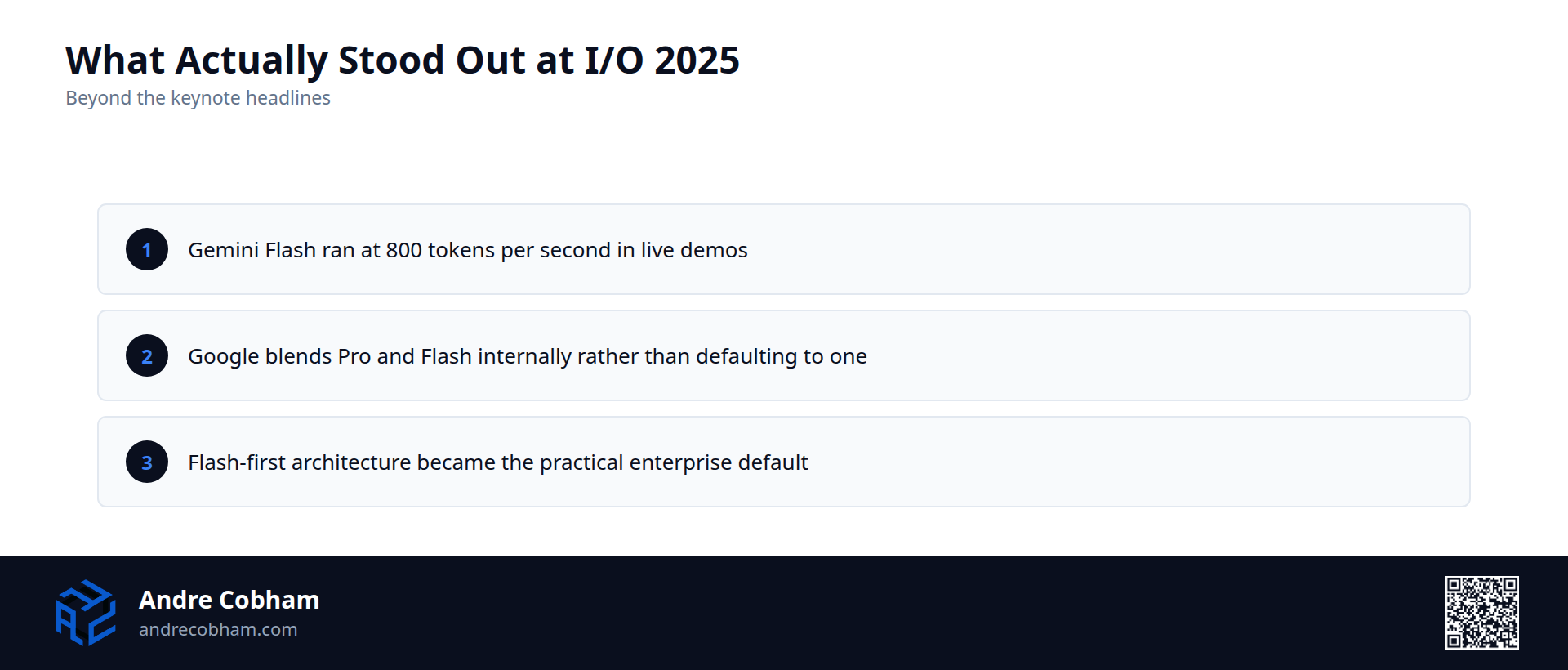
The Gemini 2.5 Pro and Flash updates were the most technically substantive product announcements at I/O. Pro pushed context window depth and multimodal reasoning. Flash pushed throughput and cost, running at 800 tokens per second in the Anti-Gravity demo. Both represent genuine capability improvements, not rebranding of existing work.
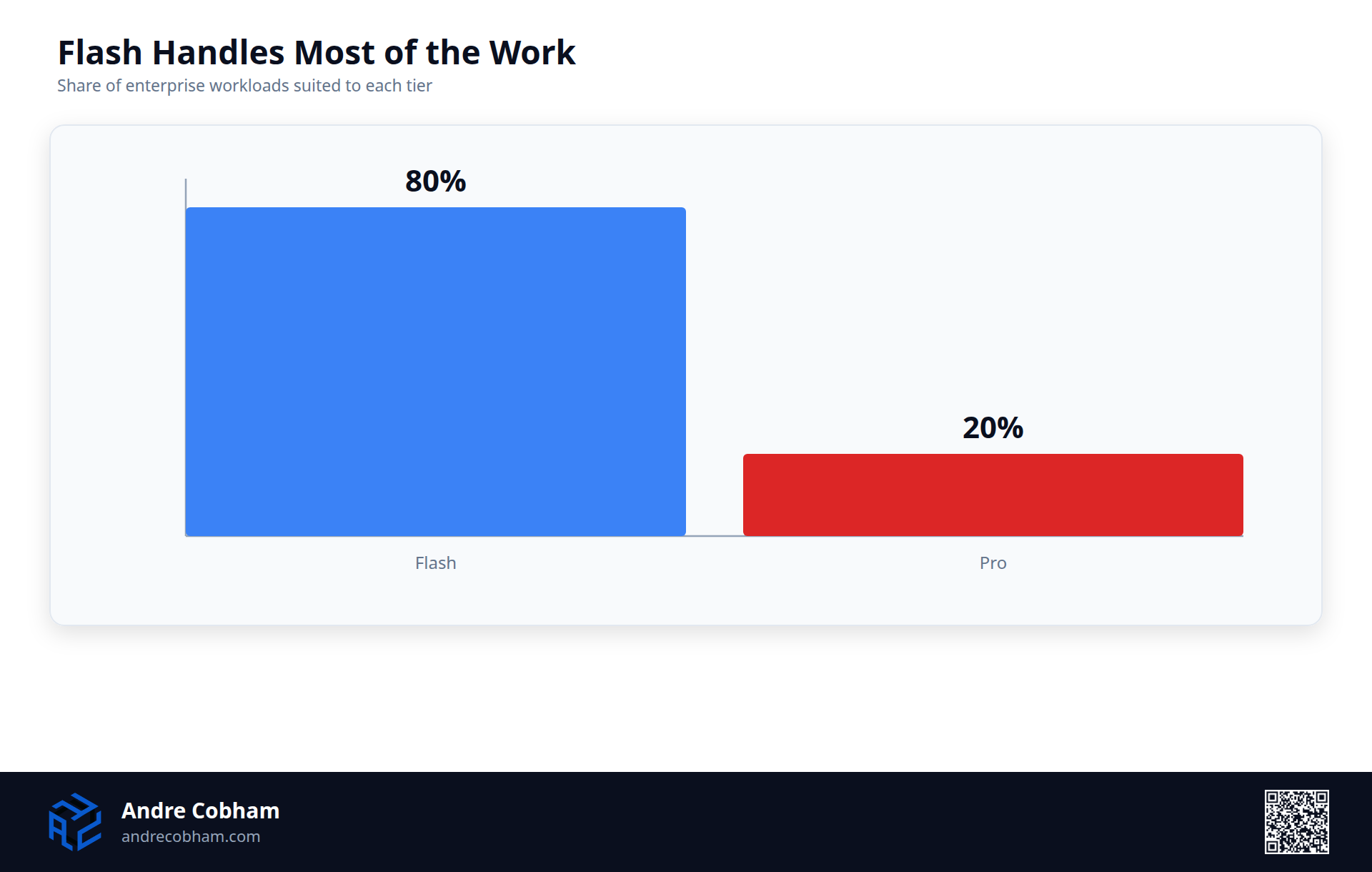
What I found more interesting than either model in isolation was Sundar's confirmation that Google internally uses a blend of Pro and Flash rather than routing everything through the most capable model. That is exactly the model-routing strategy I recommend to every client I work with. Most business tasks do not require deep multi-step reasoning over a one-million-token context window. They require reliable, consistent, fast output at a cost that does not blow through quarterly budgets. Flash handles 80 percent of real enterprise workloads well. Pro handles the 20 percent where depth matters. Running everything through Pro is a budget failure, not a quality decision.
The interesting strategic point is that Google made a deliberate choice to build a capable omni model they could deploy broadly rather than building an ultra-class model accessible to only a handful of research customers. That reflects a company thinking about AI at population scale. Not every organization needs the frontier. Most need something fast, cheap, and reliable enough to run agentic workflows without constant human intervention.
Flash Models Are the Enterprise Story
This is where I got most excited. Sundar said he has heard from CIOs across industries who are genuinely alarmed at how fast their companies are burning through AI budgets. That tracks with everything I see in the field. Businesses adopt a frontier model, deploy it across a few workflows, and then get the invoice. The math does not work at scale, especially in agentic workflows where the model gets called dozens of times per task.
Google's answer is the Flash model family. Gemini Flash ran at 800 tokens per second in live demos, and Sundar was clear that Google internally uses a blend of Pro and Flash models rather than running everything at the frontier. That is exactly the model-routing strategy I recommend to clients: use the most capable model where you need it, and use a fast cost-efficient model everywhere else. Most business tasks do not require solving math olympiad problems. They need reliable, consistent, fast output at a cost that does not blow through quarterly budgets.
The interesting strategic point is that Google chose to build a capable omni model they could give to as many people as possible rather than building an ultra-class model that only a handful of customers could access. That is a deliberate tradeoff, and it reflects a company that is thinking about AI at population scale, not just research-lab scale.
Google Agent Space and What It Actually Does
Google Agent Space was announced as the enterprise interface for deploying Gemini agents inside an organization's own data and workflow context. The practical version is a platform where an enterprise can connect internal knowledge sources, document libraries, databases, internal tools, and deploy agents that reason over that context without sending company data outside the organization's boundary.
The architecture is grounded retrieval augmented generation with an agent layer on top, but the differentiation is in the connector ecosystem and the admin controls. Google is pushing Agent Space as the answer to the question every enterprise IT team is asking: how do we use AI on our data without compliance exposure? The answer is a managed platform where the data stays in Google Cloud's tenant boundaries, the agent actions are audited, and the administrator controls what the agent can access.
For companies already on Google Workspace and Google Cloud, Agent Space is a natural next step. For companies on Microsoft 365, Microsoft Copilot Studio does the same job in the Azure tenant. The enterprise agent platform race is between these two stacks, and both are real products now, not demos.
Cybersecurity Just Got an Agentic Upgrade
One of the under-discussed announcements was Code Mender, a product Google uses internally and is building for external customers. It identifies vulnerabilities, generates patches, tests that the patches work, and deploys them. It runs around the clock. Combined with Google's acquisition of Wiz for real-time vulnerability monitoring, Google now has an end-to-end agentic security pipeline that does not sleep.
Sundar also weighed in on the debate between Anthropic holding back its Mythos cybersecurity model versus releasing frontier security AI publicly. His take was nuanced: if the model does not dramatically change the threat surface, release it. If it does, work with government first and stage the disclosure, the same way Google's Project Zero gives vendors 90 days to patch before publishing. That approach makes sense. The security industry has decades of responsible disclosure practices. AI should use them, not invent a parallel regime.
AI Platform Capabilities as of June 2025
Google's open agent protocol layer (A2A and ARD) is the differentiator no other platform has matched as of mid-2025. Everything else is roughly comparable in category, if not in execution quality.
Compute Is the Constraint Nobody Can Solve Fast Enough
Sundar confirmed what most of us suspected: Google's revenue is literally constrained by available compute. They want to serve more customers, run more inference, offer more capacity. They cannot. And the bottleneck is not one thing. It is data center construction, power supply, memory prices, and core chip components all creating parallel constraints. Solve one, and the next one becomes the blocker.
For businesses, this means two things. First, compute costs are not coming down as fast as anyone hoped. Memory prices are rising, infrastructure costs are climbing, and planned budgets are delivering less capacity than expected. Second, model efficiency is not just a nice-to-have. It is a survival strategy. The companies that learn to route between frontier and flash models, that build architectures flexible enough to swap models underneath, will spend less and get more. The companies that treat every API call like it needs the most expensive model will burn through their budgets before the year is out.
Google's Trillium TPU generation and its continued investment in custom silicon is the long-game answer to the compute constraint. Custom inference hardware gives Google a structural cost advantage on inference over anyone running on commodity GPUs. That advantage compounds over time and eventually shows up in pricing. Not this quarter. But it is the reason Google can sustain a Flash tier at the price it does.
"The businesses I work with that have already committed to blended model routing are not worried about AI budgets. The ones still running everything through frontier models are."
What I Am Not Excited About
The Project Astra demos were impressive in isolation. Real-time multimodal conversation, object recognition in live video, context that persists across a conversation session. In the demos it works. In the demos it has also worked for two years. What I want to see is Astra deployed at scale in a real product where users are not on a scripted demo path. Multimodal real-time assistants are consistently more fragile in uncontrolled conditions than the showcase suggests. I am watching, not excited yet.
NotebookLM got updates that improved audio quality and added more control over the generated discussion format. These are real improvements for knowledge workers who use it. But NotebookLM's ceiling is bounded by what it can do with documents you give it. It does not yet reason across live external sources or connect to real-time data. For clients who need research over current information, not archived documents, it still requires manual curation. Useful. Not transformative yet.
My Take
Here is where I land on Google I/O 2025. The announcements that got the most press coverage, the product demos, the new model names, those are not what matter most. What matters is the strategic posture Google laid out in this conversation. They are building for scale, not just capability. They are earning trust before shipping features. They are treating compute as a multi-bottleneck constraint and designing their model strategy around it.
For the businesses I work with, the actionable takeaway is this: if you are not already routing between model tiers, start now. Use a frontier model for the tasks that need deep reasoning and a flash-class model for everything else. Build your agent architectures to be model-swappable, because the ecosystem changes every four to six weeks and you cannot afford to be locked in. And take cybersecurity seriously at the agentic level, because if Google is running 24/7 automated vulnerability patching internally, the threat landscape has already evolved past what manual security teams can handle alone.
Google I/O had a lot of noise this year. The signal was in the strategy behind the announcements. The signal says: efficiency, trust, and responsible deployment are the actual frontier. I agree with that framing. It matches what I see working in the field every day.
Stay Current
Get notified when I publish.
No newsletter cadence. No filler. I write when there is something worth saying about AI systems, infrastructure, and what is actually working in practice.
30 Minutes. Honest Assessment. No Pitch.
You describe what is eating your time. I tell you honestly whether I can fix it, what it takes, and what it costs.