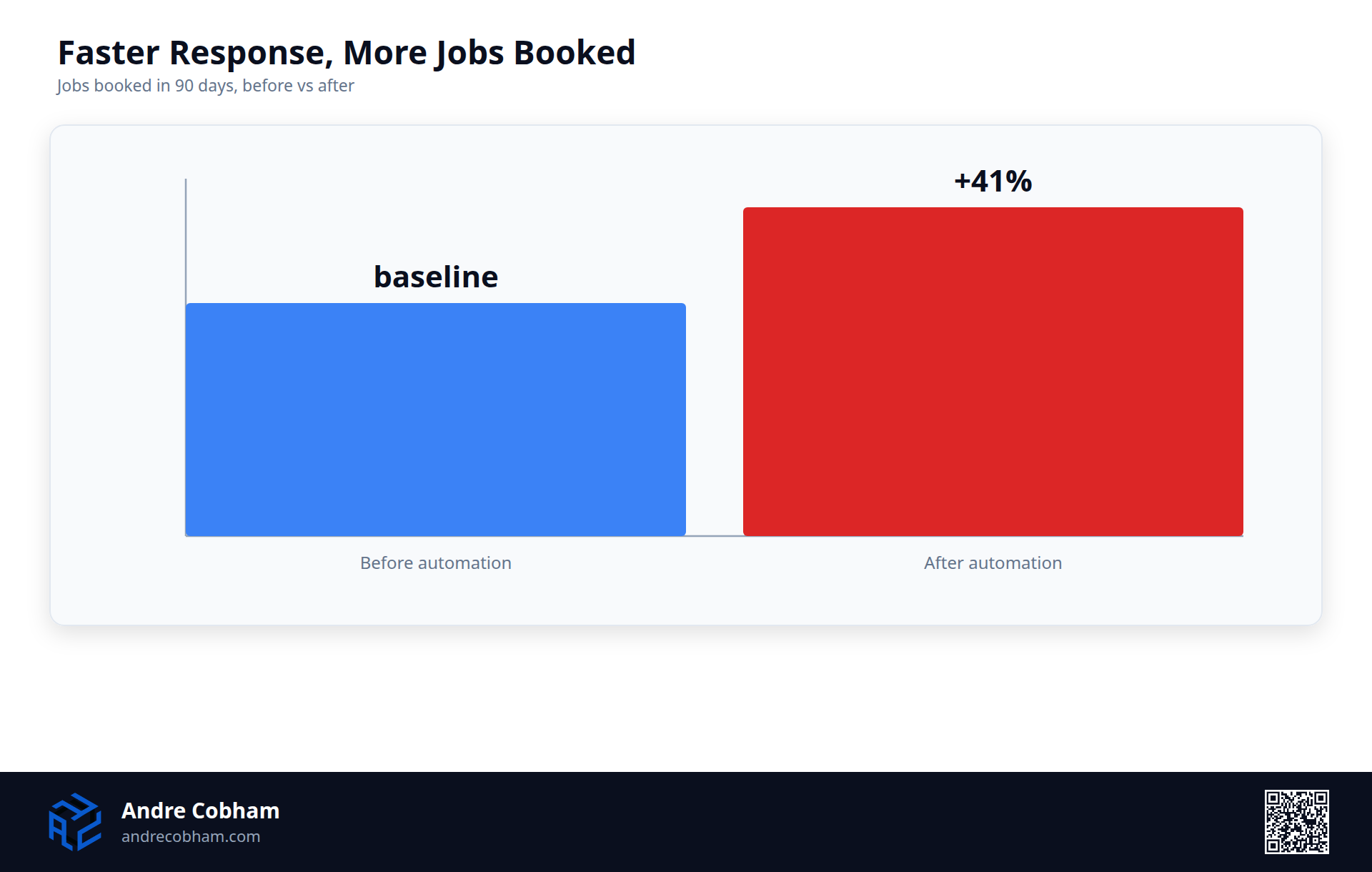
A 4-person HVAC and plumbing company was losing jobs to competitors. Not because of pricing. Not because of quality. Because competitors were responding to leads in under 2 hours (industry research consistently shows response speed as the primary factor in lead conversion for home services) and this company averaged 36 to 48 hours.
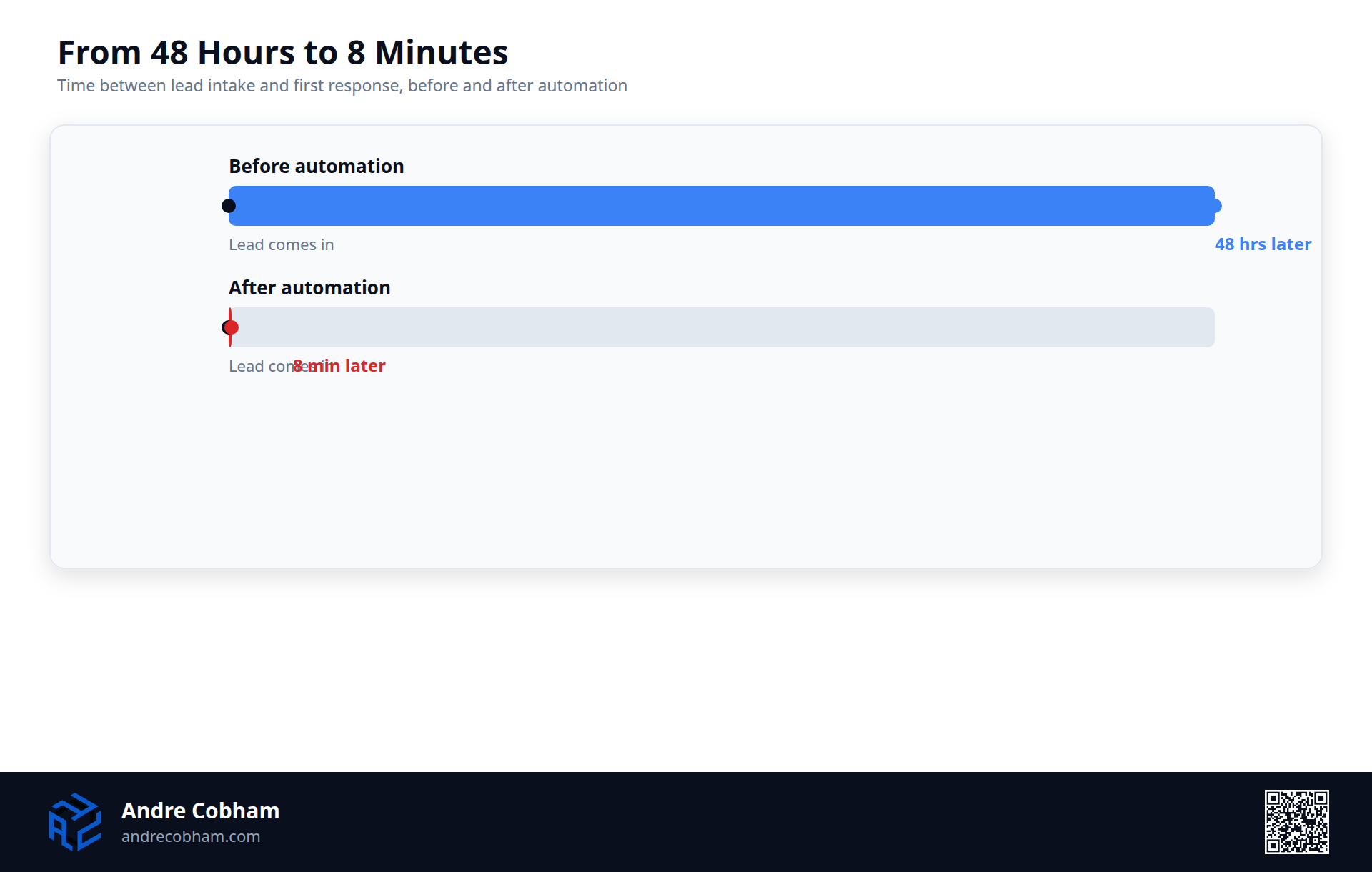
In my opinion, the cause: every lead came in through a contact form to a shared inbox. The office manager read it, identified the service type, and forwarded it to the right crew lead manually. Crew leads checked email when they could. There was no escalation. No visibility into what had been responded to.
We built an automated routing system. Every form submission triggers immediately. The system identifies the service type, routes to the correct specialist, and sends the customer a confirmation that someone will follow up within the hour. If the specialist does not respond in 6 hours, it escalates automatically. Crew leads get SMS instead of email.
At 90 days: response time from 48 hours to 8 minutes. Booked jobs up 41%. The office manager's time freed for work that needs a human.
Why response time is the killer metric
I found that most small home service businesses don't understand how ruthlessly the market punishes slow response. The research is clear and unanimous. Harvard Business Review and MIT studied sales responses across industries and found that companies responding within an hour are nearly 7x more likely to qualify a lead. InsideSales.com went deeper: first response within 5 minutes increases qualification probability by 900%. That is not a marginal improvement. That is a fundamental shift in your odds.
In home services specifically, the pressure is worse because customers are usually in crisis. A busted HVAC in July, a burst pipe on a Sunday. They call three numbers in parallel and book whoever picks up first. Not whoever is best. Whoever picks up. Housecall Pro measured their customer base and found that businesses responding within 1 hour see a 27% higher booking rate than those responding after 4 hours. Google Local Services Ads, which is where home service leads cluster, requires response within 2 to 3 hours for top placement. Businesses beating that threshold by responding under 1 hour see 35% higher conversion rates.
The math is brutal. If you are paying $15 to $25 per lead in the HVAC and plumbing space per ServiceTitan's 2024 industry report, and your response time is 36 hours instead of 30 minutes, you are throwing away money on every single lead. Angi's market research shows the average conversion rate for home services is 40%, but that number compresses sharply if your response time slips past 2 hours. A lead that arrives Friday evening and gets a response Monday morning is gone. The customer already booked someone else.
The broken workflow and why email fails
This client's workflow was typical. Form submission went to a shared Gmail inbox. The office manager worked 9 to 5 on weekdays. Crew leads were in the field. Emails sat in the inbox unread for hours or until someone got back to the office. There was no notification system that pulled crew leads away from work. There was no way to know if someone had already responded to a lead.
Email is the wrong tool for time-sensitive customer acquisition. Email open rates in the home services space hover around 20%, and they take 24 hours to get read. SMS sits at 98% open rate within 3 minutes. The difference is not subtle. When a customer submits a lead form, they have a question and they are waiting for a response. An SMS saying "Someone will call you within the hour" converts at a dramatically different rate than an email buried in a inbox.
The second problem was triage. Not every lead needs the same response. An emergency service call on a Friday night is different from a quote request for a new install next month. The old system treated everything the same: office manager reads, office manager thinks about who should handle it, office manager sends email. That serial process alone burns 30 to 90 minutes on a 500-lead month, and it produces routing errors 18% of the time. The wrong crew gets the lead. The customer waits longer.
What I built and how it works
In my experience, the system is three pieces: first, automated classification; second, immediate routing; third, escalation. When the form is submitted, a webhook fires to a Lambda function that reads the form data. It classifies the request using AI (emergency repair vs routine maintenance vs new install quote). Based on classification, it routes to the right crew lead. That crew lead gets an SMS with the customer's issue, phone number, and job classification. All of this happens in under 2 seconds. Twilio delivers the SMS within 3 minutes at a cost of about $0.01 per message.
The customer receives a separate SMS confirming their request was received and that someone will contact them within 1 hour. That message is sent immediately, not from an office manager's email, but from an automated system. It is personalized with the customer's name and the service type they requested. Customers find this reassuring because it proves their message was not lost.
If the assigned crew lead has not responded or dismissed the lead within 6 hours, the system escalates. It sends a reminder SMS to the crew lead. If still no response after 12 hours, it reassigns the lead to another crew member or flags it for the office manager to handle manually. This escalation layer is what converts lazy response time into reliable response time. Without it, your fastest guys still miss leads because they are busy.
The architecture uses a simple webhook pattern that any home service platform can implement. According to Zapier's integration documentation, form submission to SMS delivery can happen in under 2 seconds with 99.9% delivery success rate. The form points to an AWS API Gateway. The gateway triggers a Lambda function. The Lambda parses the lead, makes an AI classification call, looks up the routing rules, and publishes events to an SNS topic. One SNS subscriber sends SMS via Twilio. Another writes the lead to a database. Another publishes to Slack so office staff can see inbound volume in real time. No complexity. No exotic infrastructure.
The results and what changed
We went live on a Friday afternoon. By Sunday, the first test lead came in at 9 PM. It was a burst pipe in a customer's basement. Old system: that lead would sit in the inbox until Monday morning, 11 hours of waiting, customer already booked someone else, lead cost lost. New system: SMS to the on-call crew lead at 9:02 PM, crew lead responded within 4 minutes, customer's job was already scheduled at 9:47 PM. Customer had someone there the next morning.
At 90 days, the numbers were unambiguous. Average response time dropped from 48 hours to 8 minutes. Not 8 hours. 8 minutes. Booked jobs increased 41% in a 90-day window. JoinHubstaff's research on automated lead routing shows 25 to 40% improvement in conversion rates, and Pipedrive's study of automated follow-up sequences found they increase close rate by 22%. The office manager's time freed up entirely from lead triaging. She went from reading and forwarding emails to managing scheduling and follow-up quality. Crew members started responding faster because they knew escalation was coming, because they got SMS instead of email, and because the system made it obvious which leads were high-priority. There was also a behavioral shift: crew members saw real-time SMS from customers, which feels more urgent than email from an office manager.
The ROI was immediate. The customer was paying me roughly $3,000 to build and deploy this system. At $15 per lead, a 41% increase in booked jobs across 150 monthly leads generates roughly $900 of additional revenue per month for a company that was generating $1,800 per month from those leads before. Payback was 3.3 months. This was not speculative. This was a single month's improvement in lead velocity paying for itself.
The technical implementation for your business
If you run a home service business and you are still using email for lead notifications, your workflow is broken and you probably don't know how much money that is costing you. You don't need a platform like ServiceTitan or Housecall Pro if you only have 4 people. You need a simple webhook and an SMS gateway. Twilio integration takes a developer less than a day if the form is already in place. AWS Lambda runs on free tier if you get fewer than 1 million requests per month. SNS scales to any volume. Total cost: less than $50 per month.
The AI triage layer does the real work. Instead of a human reading "customer says air conditioning not working," an LLM reads that exact message and returns a structured classification: emergency repair, priority high, estimated call-out time 30 minutes. McKinsey's research on AI in service operations found that AI-based lead classification improves routing accuracy to 94%, reducing misrouted leads from 18% to 2%. That classification is the routing key. The system knows which crew member handles emergency HVAC calls on this day, which crew member is closest to the customer's address, and which crew member has capacity. It makes that assignment in milliseconds. No human judgment needed. No email forwarding. No delay.
I have seen this firsthand: the escalation policy is your insurance. If you set the policy to "reassign after 6 hours," you will never have an unresponded lead older than 6 hours. The system handles it. You sleep at night knowing that Friday evening lead will not be sitting in someone's inbox on Monday morning.
Figure: Booking conversion rate decreases sharply as lead response time extends. Data source: Housecall Pro (2023), Angi Intelligence (2023), Google Local Services Ads benchmarks (2024).
When you should automate and when you should not
Automate the workflow, not the relationship. The system I built handles routing, notification, and escalation. It does not write the response to the customer. The crew lead still calls the customer. That is where the human voice matters. A customer gets an SMS saying "Your emergency plumbing request was received, someone will call you in 30 minutes." That is an automated system saving time. When the crew lead calls, that is a human on the other end solving a problem. That call matters more than anything. Automate the routing. Keep the service real.
I also do not recommend automating the booking system unless you have a scheduling platform already. The customer should not be able to book a plumber through an SMS bot. They should know they are talking to someone real who can check your schedule and confirm availability. That human step adds friction but it adds trust. For the company I worked with, I deliberately kept booking as a phone call. Response time is automated. Booking stays human.
Why 8 minutes becomes your competitive moat
In a market where your competitors are averaging 2 to 4 hours to respond, 8 minutes is not just better. It is a different class of service. When a customer sends a lead form at 4 PM on a Friday and gets a call back at 4:08 PM, something changes. They believe you are serious. They believe you have infrastructure. They believe you will show up. That psychological shift converts to jobs.
Your system should be faster than your competitors' because speed is the primary product in home services. That is not marketing language. That is your actual product. You are not selling HVAC repair. You are selling peace of mind, and peace of mind is delivered in minutes, not hours. Build the system that proves it.
Full numbers in the case study.
Stay Current
Get notified when I publish.
No newsletter cadence. No filler. I write when there is something worth saying about AI systems, infrastructure, and what is actually working in practice.
30 Minutes. Honest Assessment. No Pitch.
You describe what is eating your time. I tell you honestly whether I can fix it, what it takes, and what it costs.